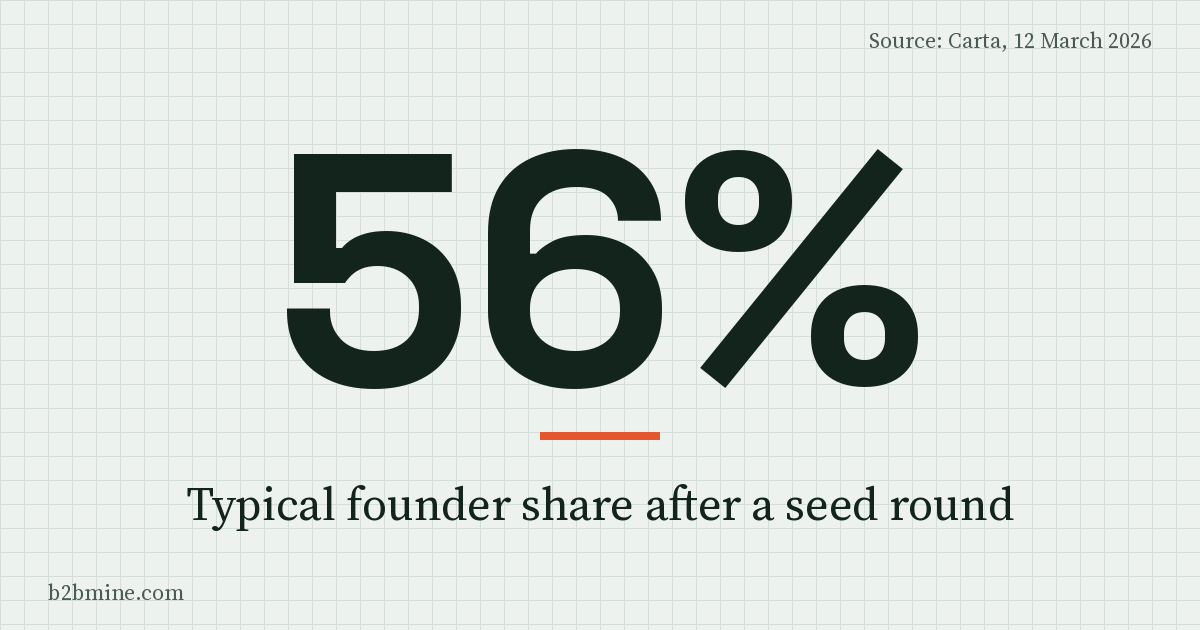
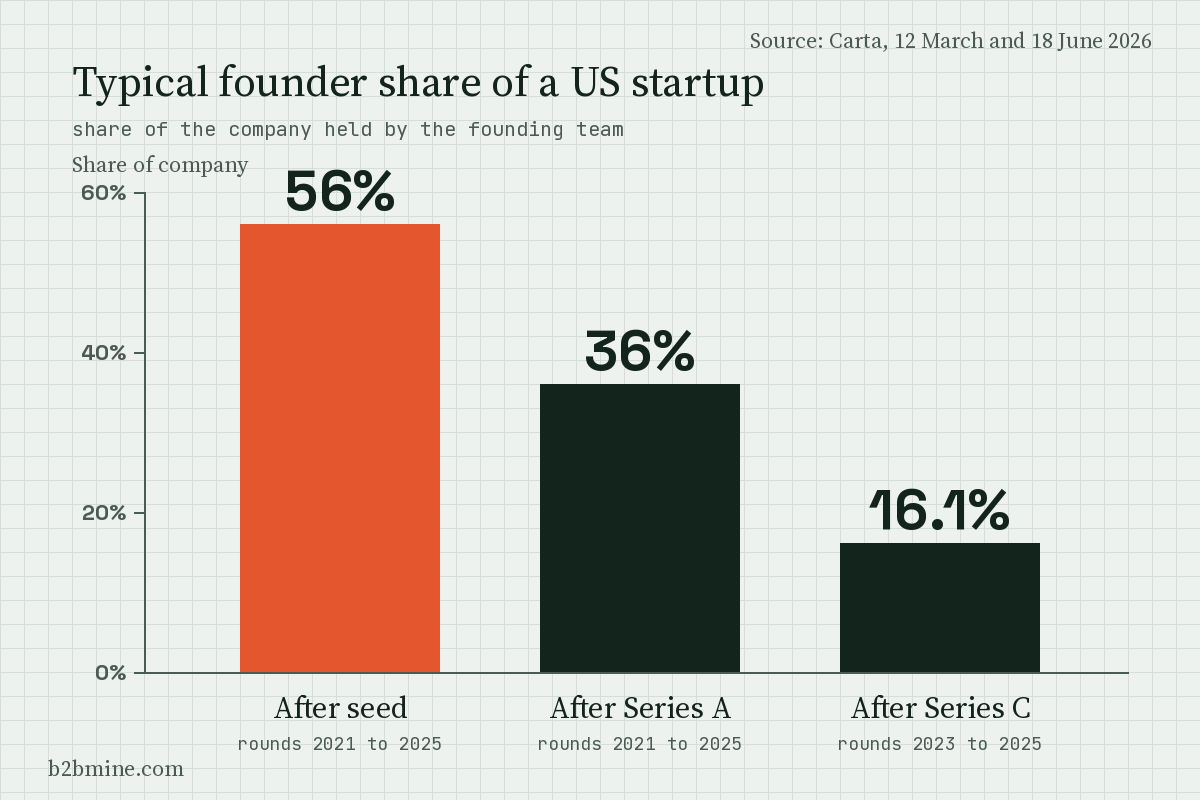
Carta's Founder Ownership Report 2026, published 12 March 2026, puts the typical US founding team at 56% of the company after a seed round. That falls to 36% after a Series A.
The data covers startups that raised rounds from 2021 through 2025, as of 1 January 2026. This is how much equity founders get to keep once outside money comes in.
Four conditions change it.
Your industry. Founders in digital industries hold 7 points more than founders in physical industries at Series A, per Carta's 2026 report.
AI or not. Founders at AI companies hold more at every stage, by differing amounts, and the gap at Series B is 5.5 points, per Carta's 2026 report.
The employee pool. At seed the pool holds 12.1% of the company, per Carta's 2026 report, so founders share what is left after investors and staff.
Who counts. Carta's 2026 report counts people who held at least 5% before any venture round, at US companies only.
Equity founders get on day one: 51% and 49%
Carta's data published 18 June 2026 puts the usual split of two founder teams formed in 2025 at 51 to 49. For teams formed in 2021 it was 57 to 43.
Equal splits reached 44.6% of two founder teams formed in 2025, up from 34.5% for teams formed in 2016, in the same data.
Two founder teams closed 36% of the rounds on Carta in 2025. Solo founders closed 20% of them, per Carta's data published 18 June 2026.
Larger teams split less evenly. Carta's Founder Ownership Report 2026 puts equal splits at 27.3% of three founder teams in 2025, up from 21% a year earlier.
For four founder teams the report gives 16.7%, up from 10.8%. Carta's data published 18 June 2026 covers teams of three to five founders over the past five years.
In that data, the lead founder usually holds at least 10 points more than the next founder.
In biotech, Carta's data published 18 June 2026 puts the lead founder of a typical two founder team at 58%.
Teams also break up. Carta found that from 25% to 35% of two-founder teams formed from 2016 to 2021 had parted ways after five years.
The share depends on the year the team formed. Carta found more than 40% of two founder teams formed from 2016 to 2018 had parted ways within eight years.
Two person teams founded about 36% of new startups in 2025, per Carta's data published 18 June 2026. Solo founders led another 36%, up from 31% in 2024, per the Founder Ownership Report 2026.
Short answers to nearby questions.
Question | Short answer |
|---|---|
Should cofounders be 50/50? | Many are. Carta found 44.6% of two founder teams formed in 2025 split equally, and the usual split was 51 to 49. |
How much equity does Y Combinator take? | 7% for $125,000, plus $375,000 whose share your next investors' terms set, per Y Combinator's deal page as of 15 October 2026. |
Seed: 56% of the company
After a seed round, the typical founding team holds about 56% of the company, according to Carta's Founder Ownership Report 2026, for rounds raised from 2021 through 2025.
The other 44% sits with investors, the employee pool and other holders. For how much a seed round itself sells, read how much equity to give investors.
Series A: 36% of the company
The typical founding team holds 36% after a Series A, per Carta's Founder Ownership Report 2026. That is 20 points below the seed figure.
The report puts founders in digital industries at 37.5% at that stage, and founders in physical industries at 30.5%.
Series B: 27.3% with AI, 21.8% without
At Series B, Carta's Founder Ownership Report 2026 puts the typical founding team at an AI company at 27.3% of the company.
The typical team at any other company holds 21.8%, in the same report. The gap between AI and other companies shows up at every stage, by differing amounts.
Series C: 16.1% against 16.8% for employees
Carta's data published 18 June 2026 puts the typical founding team at 16.1% after a Series C, and the typical employee pool at 16.8%.
Both figures cover rounds raised from 2023 through 2025. Staff as a group now hold more than the founders do. Who owns what after each round is laid out under startup equity.
If a Series A buys 20% of the company
Say a made up two founder restaurant inventory software company has just closed its seed round. It has 10,000,000 shares.
The founders hold 5,600,000, the employee pool holds 1,200,000 and earlier investors hold 3,200,000. A Series A investor now buys 20% of the company after the round.
The 10,000,000 shares that exist today will make up 80% of the company after the round.
10,000,000 divided by 80% is 12,500,000 shares in total.
The company issues 2,500,000 new shares to the Series A investor.
The founders still hold 5,600,000 shares. 5,600,000 divided by 12,500,000 is 44.8%.
This table shows who holds what before and after the Series A.
Holder | Shares before | Share of company before | Shares after | Share of company after |
|---|---|---|---|---|
Founders | 5,600,000 | 56.0% | 5,600,000 | 44.8% |
Employee pool | 1,200,000 | 12.0% | 1,200,000 | 9.6% |
Earlier investors | 3,200,000 | 32.0% | 3,200,000 | 25.6% |
Series A investor | 0 | 0.0% | 2,500,000 | 20.0% |
Total | 10,000,000 | 100.0% | 12,500,000 | 100.0% |
The founders go from 56.0% to 44.8% in this one round, a drop of 11.2 points.
Carta's Founder Ownership Report 2026 puts the typical US founding team at 56% after a seed round, for rounds raised from 2021 through 2025. The same report has it at 36% after a Series A.
Carta's data published 18 June 2026 has it at 16.1% after a Series C. For two founder teams formed in 2025, the usual split is 51 to 49, per that same data.
Your own figure depends on your industry, your cofounders, and how much each round sells. Use these numbers as a guide, because they describe past US rounds.
Write down the share you want after each round, then compare it with the Carta figures above.
Use these figures as a starting point, then ask a startup lawyer about your own deal.