If you join Y Combinator's cofounder matching, you wait up to a week for approval and can then send 15 invites a week, per the Startup School FAQ as of 26 November 2026.
Anyone looking for a cofounder can use it, with or without an idea, and YC takes no equity.
Its matching page reports more than 100,000 matches.
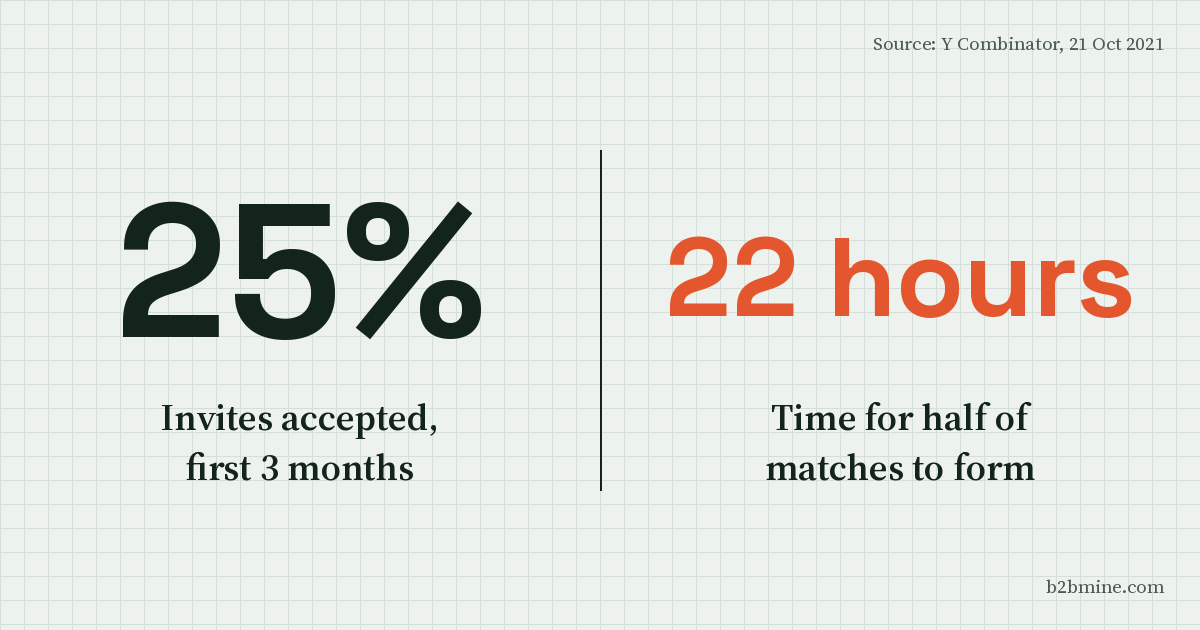
In its first 3 months, across profiles from the US and 145 other countries, 25% of invites were accepted, and half of the matches formed within 22 hours, per YC's post of 21 October 2021.
If you are setting up your profile
The FAQ says the profile asks for your education, your employment, and anything else you want to share, plus what you want in a cofounder.
You can browse other profiles only after YC approves yours. YC's post of 21 October 2021 lists the preferences you can set.
They are whether your match is technical, an area of skill, the hours each week, a location, and shared interests. You mark each one as a must-have, a flexible preference, or not important.
Few founders called those must-haves. In that post, 79% cared about hours, and only 15% called them a must-have. 74% preferred shared interests, and 13% called them a must have. Half did not care where their cofounder lived.
Profiles are not public on the internet. Only people approved for matching can see yours. You can join with a company already running, or with no idea at all, and you can have one cofounder and still look for another.
The first three months showed who joins. 42% of profiles called themselves technical, 43% worked 40 or more hours a week on a startup, and 22% worked 20 to 40 hours.
Of the founders not yet working on a startup, 47% planned to start within 3 months and another 21% within 6 months.
Short answers to nearby questions:
Question | Short answer |
|---|---|
How does YC cofounder matching work? | You make a profile, the site shows close fits, you send a personal message, and a match forms if they accept (YC, 6 July 2021). |
Is YC cofounder matching free? | Yes. YC takes no equity and attaches no conditions (YC matching page, 26 November 2026). |
Does YC cofounder matching work? | YC reported 33,000 matches in 3 months (21 October 2021), and two matched pairs joined its Summer 2021 batch (24 November 2021). |
Is YC cofounder matching good? | Reported results: 25% of invites accepted, half of matches within 22 hours (YC, 21 October 2021). Fit depends on your own calls. |
Does Y Combinator offer a cofounder matching platform? | Yes. YC also runs in person meetups in San Francisco and New York City (YC matching page, 26 November 2026). |
Who can join YC cofounder matching? | Anyone seriously looking for a cofounder, solo or not, with or without an idea (Startup School FAQ, 26 November 2026). |
Can employers see your profile? | The profile is not public. Only people approved for matching can see it (Startup School FAQ, 26 November 2026). |
How do you log in? | Use Sign in on YC's matching page. Matching sits inside Startup School, per its FAQ (26 November 2026). |
How long does a reply take? | Half of matches are formed within 22 hours of the invite, and 75% within 4.5 days (YC, 21 October 2021). |
When you send your first invite
The site shows the profiles that fit your preferences most closely. You send a personal message. If the person accepts, YC emails you both.
The FAQ limits you to 15 invites a week.
Say a made-up founder of a hotel housekeeping scheduling company sends 15 invites in each of 4 weeks.
15 invites a week for 4 weeks is 60 invites.
If 25% are accepted, as in YC's first 3 months, 25% of 60 is 15 matches.
Replies came fast in 2021. Half of the matches formed within 22 hours of the invite, and 75% within 4.5 days.
A quarter formed after the 4.5-day mark. Among matches where founders said they met online or in person, half met within 6.2 days.
If you need an engineer
Engineers are the skill most founders asked for. In YC's October 2021 data, 31% of founders did engineering, and 62% preferred a cofounder who does. That is twice as many.
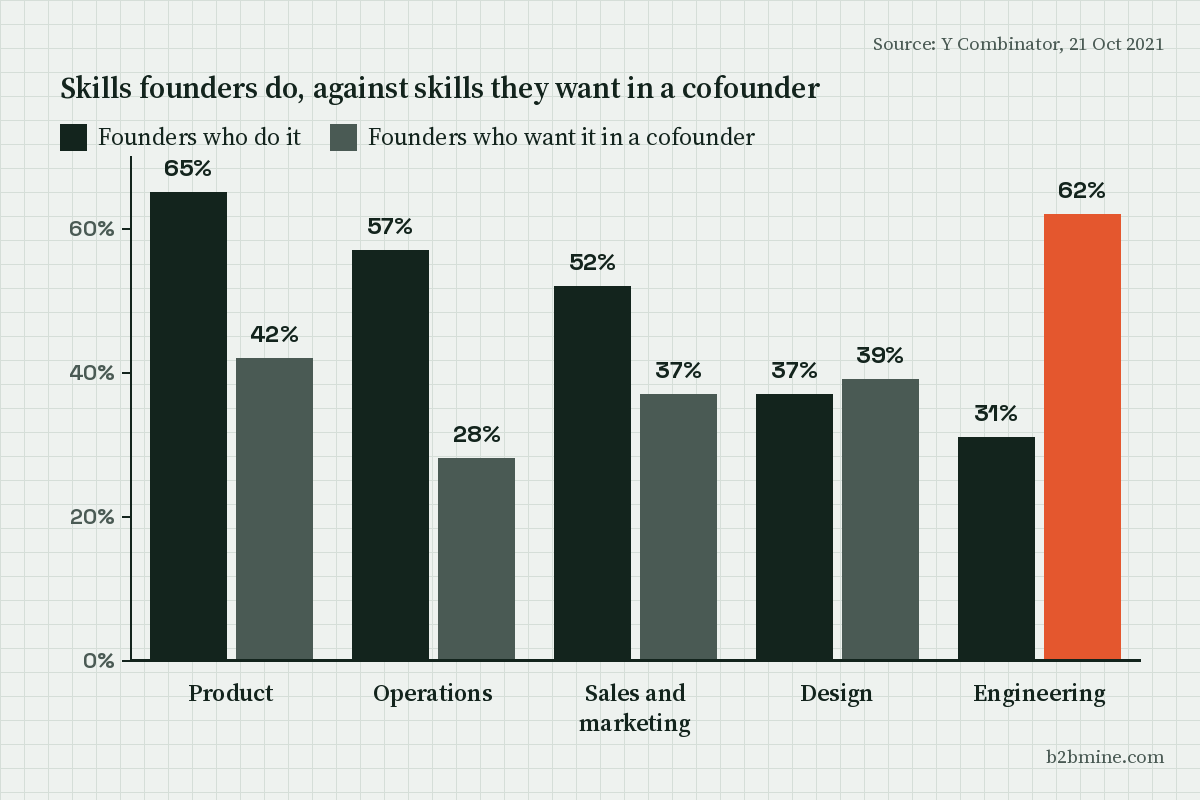
Among founders who did not do engineering, 80% wanted an engineer. Engineers averaged 4.8 matches per person, against 3.6 for all founders.
Founders who were not tied to an idea averaged 5.1. In 68% of matches, a technical founder was paired with a non-technical one.
For places beyond YC, see six other places to meet engineers.
When the first calls go well
Startup School's FAQ recommends a video call as soon as you match, then a trial project before you commit. It lists seven questions for that first call.
They cover whether either of you has an idea you definitely want to work on, how each of you handles stress, and what ideal path each of you wants, from a venture-backed company to a lifestyle business.
For the trial project, the FAQ suggests 2 to 4 weeks of close work. It asks you to write down the project, the hours each of you can give each week, how often you check in, and how long you will test the fit.
YC's rules add two limits. Being slow to schedule a meeting after a match can get you removed. So can contacting a match on another site, such as LinkedIn, without permission.
YC's matching page names four companies whose founders met there: Whalesync, AccessOwl, Pledge Health and Clearspace. It also lists in-person matching meetups in San Francisco and New York City.
Two pairs who met this way joined YC's Summer 2021 batch, per its post of 24 November 2021: Kiwi Biosciences and Sequin.
Sequin's founders met in person the day after they matched, and the company raised $5.7 million.
Kiwi Biosciences, 2021
Anjie Liu started Kiwi Biosciences with a founding scientist for the research. She wanted a cofounder to build a consumer brand and sell the product.
She found David Hachuel's profile on YC's matching site, and he had sold a startup in the same space. Both answered all 50 questions in First Round's cofounder questionnaire.
They then ran a trial that lasted a month, and the go or no-go decision was easy, according to YC.
They worked remotely for 4 months and first met in person after YC accepted them into its Summer 2021 batch.
The company raised $1.5 million, per YC's post of 24 November 2021.
Once you both decide to commit, the split comes next, and the posts on dividing shares cover it.
Write down the skill you want, the skill you bring, and the hours you can give each week before you fill in your profile.
Then read what a technical cofounder usually gets so the split talk starts from real figures.
Use these figures as a starting point, then ask a startup lawyer about your own deal.