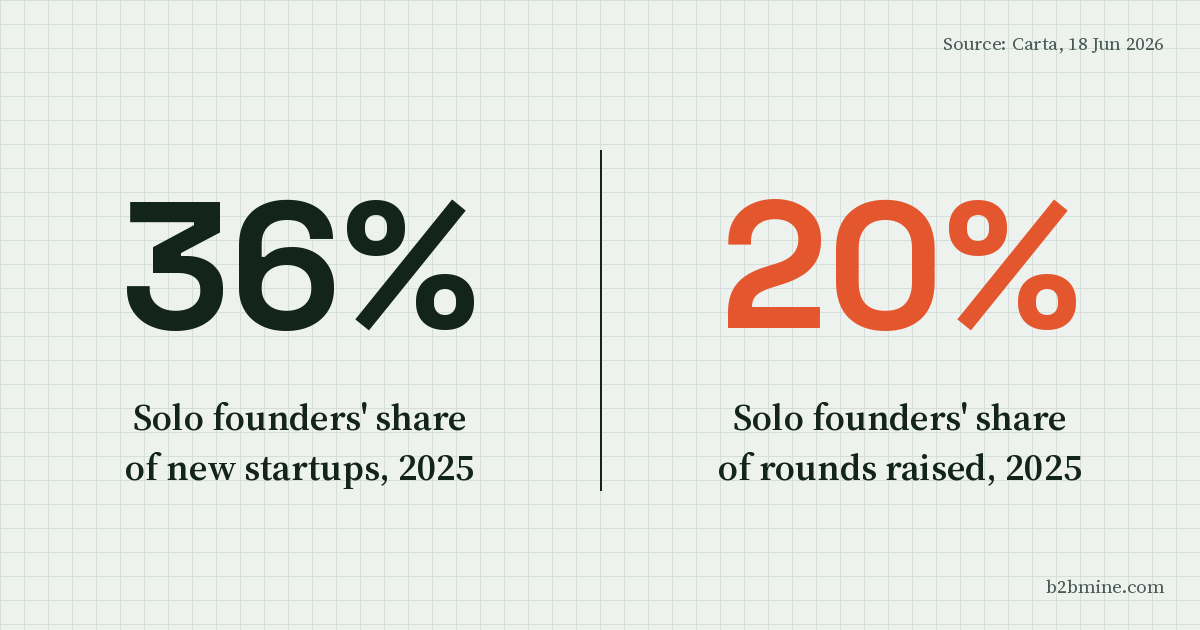
Solo founders started 36% of new companies on Carta in 2025 but raised only 20% of the funding rounds closed that year, according to Carta's report of 18 June 2026.
Two founder teams started another 36% and raised 36% of the rounds. If you are working out how to find a technical cofounder, the seven places below put you in front of engineers who want to start a company.
The facts come from each place's own page as of 20 November 2026, and the money terms are those quoted for US programs.
Every place on this list had to pass four tests. It is open to a founder without a technical partner.
Engineers join it to start companies. Its own page states what it costs or what it takes. It is running today.
An engineer who joins on a salary is a hire, with the equity a hired CTO gets instead of a founder's share.
Matching sites cost little or nothing to join. Programs that invest give you money and support, and they take a share of the company in return.
3 places to find a technical cofounder online
These three run online. Two are free, and the third has a free plan with limited search.
YC Co-Founder Matching
Y Combinator runs it as a free product and takes no equity, according to its page.
The page reports over 100,000 matches made.
You create a profile, the site shows profiles that fit what you want, and a match forms when someone accepts your invite.
Profiles are seen only by other approved users.
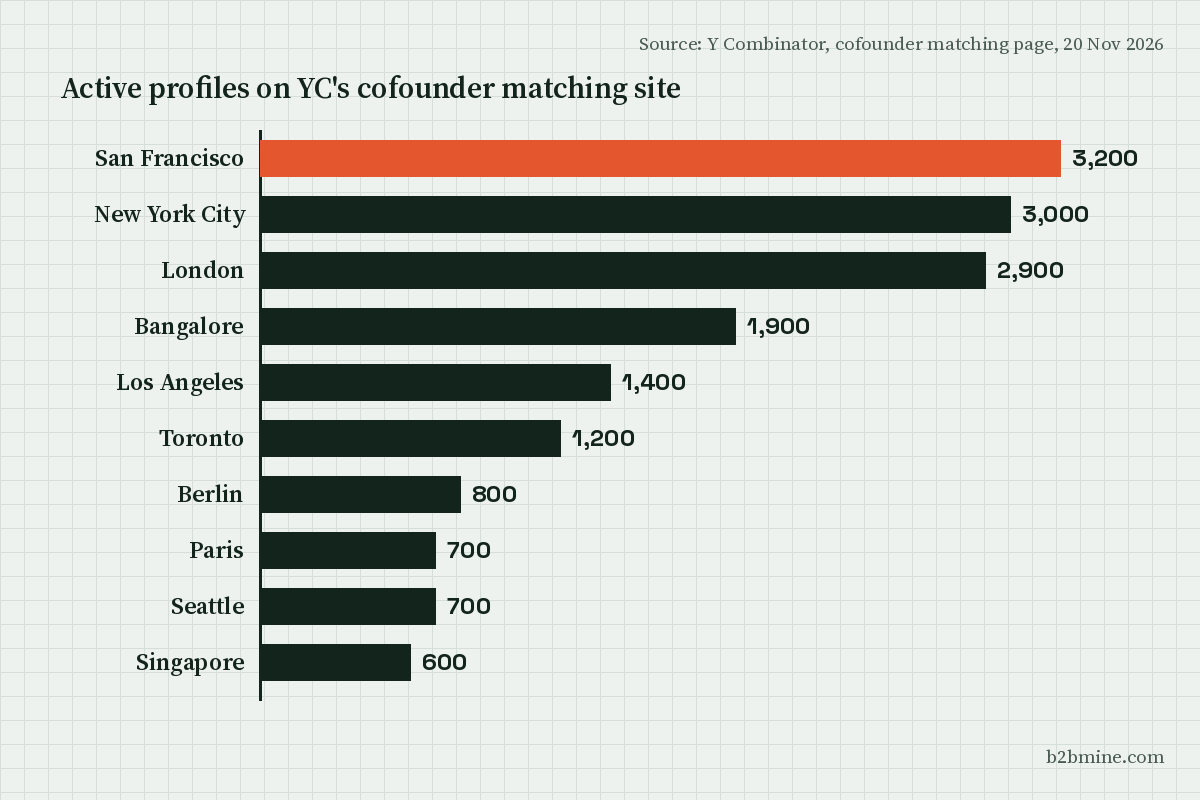
YC also runs in-person matching meetups in San Francisco and New York City.
Startup School
Startup School is Y Combinator's free online course, and its page lists finding your cofounder as one of the things it helps with.
It takes about 7 weeks at 1 to 2 hours a week, according to its page.
The course is open to anyone at an early stage, including people turning a side project into a company.
CoFoundersLab
CoFoundersLab's home page reports 700,000 users across more than 200 cities on 6 continents.
The free plan gives limited search. Premium costs $29 a month after a 30-day free trial and adds unlimited search, per its premium page.
Its home page names no figure for how many members have found a cofounder there.
Short answers to nearby questions:
Question | Short answer |
|---|---|
Where can you find a technical cofounder for free? | YC's cofounder matching site and Startup School cost nothing, and YC takes no equity for matching (Y Combinator, 20 November 2026). |
Do cofounder programs take equity? | Some do. South Park Commons pays $400,000 for 7%, per its post of 8 July 2026. |
4 programs, from hackathons to $400,000 for 7%
These four bring founders and engineers into the same room. Three of them invest money for a share of the company.
Entrepreneurs First
Entrepreneurs First takes in individuals before they have a cofounder. Its FAQ describes a 12-week program in a local hub, then a 12-week program in San Francisco.
The FAQ says 80% of participants find a cofounder within 8 weeks.
EF pays an equity-free grant to cover living costs. Teams that pass its investment committee and move to San Francisco can get up to $250,000 of equity investment, and Entrepreneurs First sets terms for each local program.
EF says its companies usually raise $1 million to $7 million within a couple of weeks of pitching at its San Francisco Demo Day.
Antler
Antler lists US offices in New York City, Austin, and San Francisco on its US page.
Its first check is usually $500,000 to $1 million, plus $650,000 in partner credits, per the same page.
Antler reports more than 12,000 founders supported and more than 1,600 companies invested in.
The same page says 85% of companies from a recent batch raised more money within 6 months. It gives no share of the company for the first check.
South Park Commons
The SPC Founder Fellowship pays $400,000 for 7% up front and guarantees $600,000 in your next outside round, per South Park Commons in its post of 8 July 2026.
$400,000 divided by 7% is about $5.7 million, the value that deal puts on the company.
Its FAQ says about 70% of members are founders who want to start a company, and 30% are researchers and experts. Many join as members first and move to the Fellowship once they have a firm idea.
Major League Hacking
Major League Hacking reports more than 5 million developers, more than 1,000 events a year and 100 countries on its home page.
It helps organizers run hackathons and developer events, where you can build with an engineer before any talk of shares.
Its home page shows no fee for attending an event.
Ask before you sign:
What share of the company does the program take, and at what value?
Does the money come as a SAFE or as shares?
What happens to the shares if you and your cofounder split up during the program?
Do you have to move city, and for how long?
Compare what each program takes in equity against what it gives you before you apply.
Then read about the split most founding teams choose once you find your partner.
Every deal is different. An accountant or startup lawyer should look at yours.