If your technical cofounder starts with you on day one, expect close to an even split.
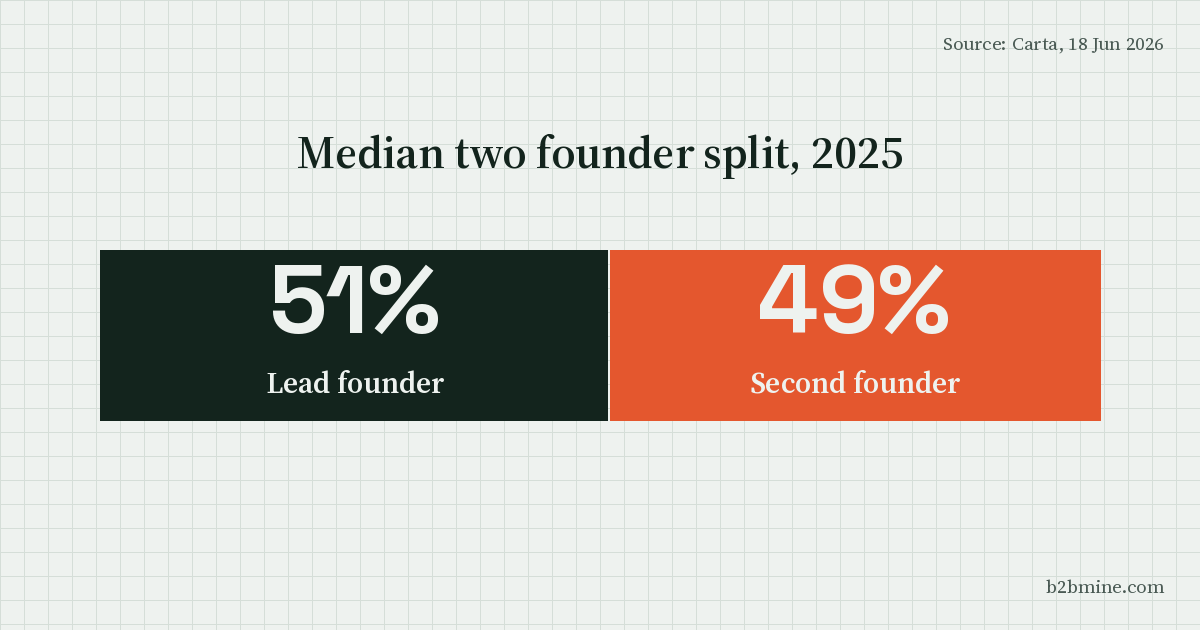
In 2025, the median two-founder team on Carta split its equity 51 to 49, according to Carta's report of 18 June 2026, and 44.6% of those teams split it exactly in half.
The data covers new companies formed on Carta. For how much equity a technical cofounder gets after an MVP or a first raise, Y Combinator in its essay of 2 December 2015 still points to an equal or close to equal share.
Expect a different number if:
your team has three to five founders: Carta finds the lead founder usually holds at least 10 points more than the next founder.
the company grows out of one founder's research: in biotech, the lead founder of a typical two-founder team holds 58%.
Your team formed a few years ago: the median split for teams formed in 2021 was 57 to 43.
Your cofounder leaves early: vesting decides how many of the shares they keep.
Two founder teams: 51% and 49% in 2025
Since 2016, two founder teams have been the most common team size among new companies on Carta, tied with solo founders in 2025.
Their way of splitting equity has moved toward the middle.
In 2016, 34.5% of two founder teams split their equity equally. By 2025, that share had reached 44.6%, the highest point of the past decade.
When the split is not equal, the gap has shrunk too.
The median split was 57 to 43 for teams formed in 2021. For teams formed in 2025, it was 51 to 49.
Three to five founders: the lead holds 10 points more
Bigger teams split less evenly, and that pattern has held for five years. In teams of three, four or five founders, the lead founder usually gets at least 10 percentage points more than the next founder, per Carta.
A technical cofounder who joins a team of three may therefore hold less than the lead founder, even on day one.
Biotech: 58% for the lead founder
In SaaS, the median two-founder team of the past three years split 51 to 49. That matches the figure across all sectors.
Biotech leans the other way. The lead founder of a typical two-founder biotech team holds 58% of the company.
Carta links this to research that often starts with a single founder, whose work makes the company possible.
Short answers to nearby questions:
Question | Short answer |
|---|---|
How much equity should cofounders get? | The median two founder team formed in 2025 split 51 to 49 (Carta, 18 June 2026). |
How much equity should a late cofounder get? | Y Combinator's essay still favors an equal or close to equal split, even after an MVP or a raise (Y Combinator, 2 December 2015). |
How much equity does a CTO cofounder get? | A founding CTO shares the founder split, which ran 51 to 49 at the median for two founders in 2025 (Carta, 18 June 2026). |
How often do two founders split equally? | 44.6% of two founder teams formed in 2025, up from 34.5% in 2016 (Carta, 18 June 2026). |
What vesting do founders get? | Four years with a one year cliff is the usual setup in Y Combinator's essay (Y Combinator, 2 December 2015). |
How many cofounder pairs break up? | 25% to 35% of two founder teams formed from 2016 to 2021 parted ways within five years (Carta, 18 June 2026). |
Does the lead founder get more in bigger teams? | Yes. In teams of three to five, the lead founder usually holds at least 10 points more (Carta, 18 June 2026). |
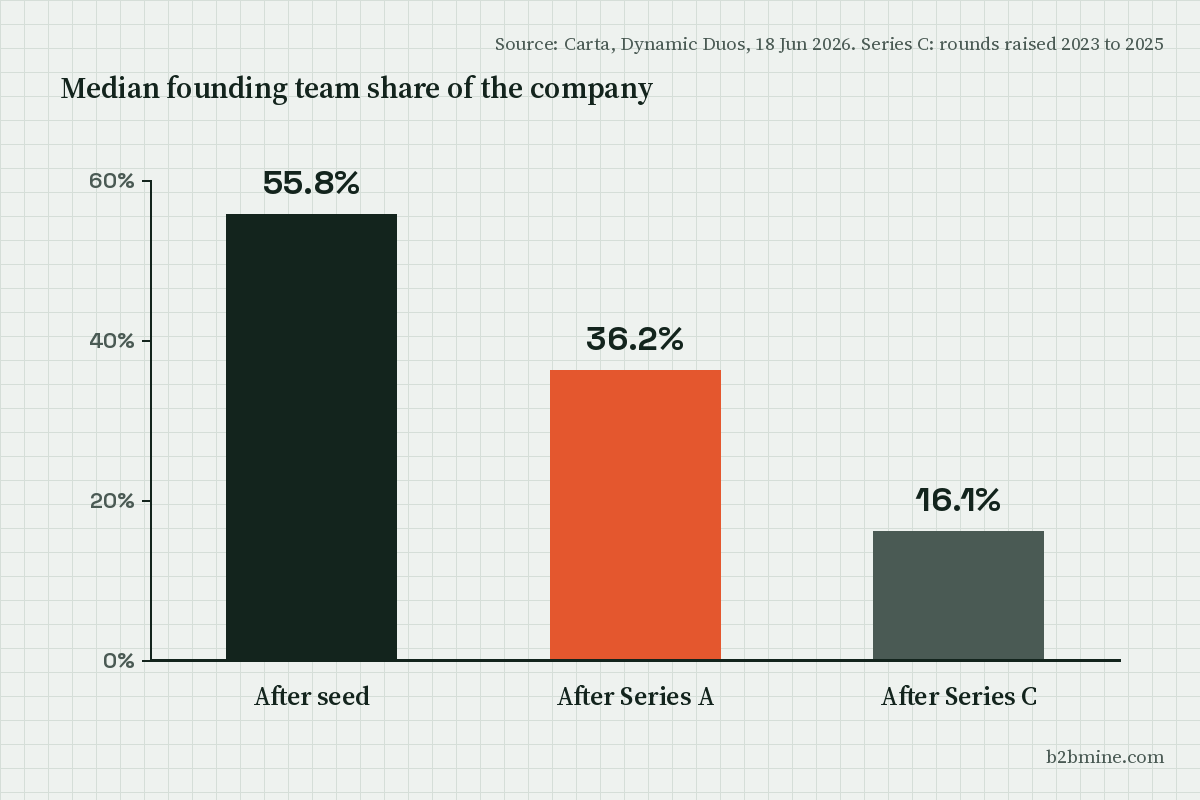
What do founders hold after a Series A? | The median founding team holds 36.2% of the company (Carta, 18 June 2026). |
What do founders hold after a Series C? | The median founding team holds 16.1%, below the 16.8% employee pool, for rounds raised from 2023 to 2025 (Carta, 18 June 2026). |
Technical cofounder equity after an MVP or a raise
Many founders want to give a late cofounder a smaller share. Michael Seibel of Y Combinator listed the usual reasons in his essay, including bringing a cofounder on after launching an MVP or after raising money.
He argued for equal or close to equal splits anyway. A company of great value takes 7 to 10 years to build, he wrote, so a head start in year one should not set the split for the years after it.
He also wrote that investors read the founder split as a sign of how the CEO values the cofounders.
A CTO who joins later on a salary is a hire, not a cofounder, and gets a hired CTO's grant instead.
The whole founding team's share shrinks once investors come in. Carta's median founding team holds 55.8% of the company after the seed round and 36.2% after the Series A.
Breakups: 25% to 35% of pairs part within 5 years
Most pairs stay together long enough to raise several rounds, but many do not. Among two founder teams formed from 2016 to 2021, between 25% and 35% had parted ways after five years, depending on the year.
For teams formed from 2016 to 2018, more than 40% broke up within eight years.
Vesting decides what a departing cofounder keeps. Y Combinator's essay names four years of vesting with a one year cliff as a usual setup.
Nothing vests in the first year, 25% vests at the one-year mark, and 1/48 of the shares vests each month after that.
Made-up pair: 49% on paper, 26.5% after a break
Say a made-up two-founder food truck ordering software company issues 9,600,000 shares at the start. The business founder takes 4,896,000 shares, which is 51%.
The technical cofounder takes 4,704,000 shares, which is 49%. Both sign four years of vesting with a one year cliff.
At the cliff, the technical cofounder earns 25% of 4,704,000. That is 1,176,000 shares.
After the cliff, 1/48 of 4,704,000 vests each month. That is 98,000 shares a month.
The technical cofounder leaves after 18 months, six months past the cliff. Six months of vesting adds 588,000 shares.
1,176,000 plus 588,000 is 1,764,000 vested shares.
The other 2,940,000 shares were never earned, so the technical cofounder does not keep them. The two founders now hold 6,660,000 shares between them.
The table shows the split before and after the break.
Holder | Shares before | Share of company before | Shares after | Share of company after |
|---|---|---|---|---|
Business founder | 4,896,000 | 51.0% | 4,896,000 | 73.5% |
Technical cofounder | 4,704,000 | 49.0% | 1,764,000 | 26.5% |
Without vesting, the departing cofounder would have kept all 4,704,000 shares.
Now say the pair stays together and tracks Carta's medians. After a seed round, the founding team holds 55.8% of the company. The technical cofounder's 49% of that is about 27.3% of the company.
Write down each founder's start date, role, and vesting terms before you settle the split. Then check what each funding round takes from it.
This is general information. Have a startup lawyer check your own papers before you sign.