You can compare startup CTO equity once the role and salary are settled.
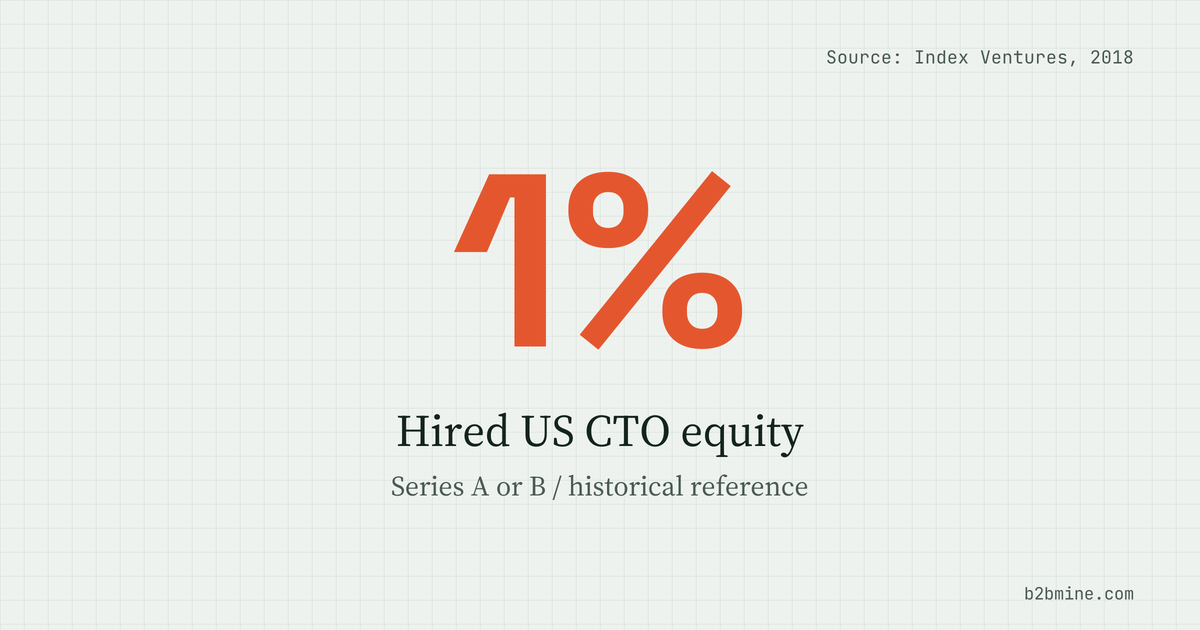
Index Ventures gives a 1% reference for hired US CTOs at Series A or B in its 2018 handbook. That figure is historical guidance for salaried hires.
A technical cofounder needs a separate founding split.
Check these before you use the number:
Your CTO joins as a cofounder: the discussion starts with founding ownership.
Your CTO takes a salary: compare the grant with salaried executive roles.
Your CTO gives up cash pay: record that cost alongside the extra options.
Your CTO works part time: agree the hours and duties before comparing packages.
The wider startup equity topics separate founder ownership, employee grants and investment rounds.
Founder work and the ownership split
A technical cofounder may build the product and share responsibility for the company. The work can include customers, fundraising, and hiring alongside engineering.
Y Combinator recommends equal or near-equal founder splits in its guidance dated 2 December 2015. It asks founders to value the work ahead when dividing ownership.
That guidance concerns genuine cofounders. Someone joining an established engineering team on salary needs an employee compensation discussion.
Before setting the split, write down who owns the product work and business decisions. Include the commitment each founder makes if the company cannot pay salaries.
YC's 2 December 2015 guidance also describes a common US founder schedule: 4 years of vesting with a 1-year cliff. Under that schedule, 25% vests after the first year.
The agreement controls what happens if a founder leaves.
A first employee building the product has a different comparison. The page on grants for the first engineer covers that role.
Short answers to nearby questions:
Question | Short answer |
|---|---|
How much equity does a CTO usually get? | Index's 2018 US Series A or B CTO reference is 1%. The role, salary, and stage affect the comparison. |
Is 1% equity a lot in a startup? | It matches Index's 2018 US Series A or B CTO reference. It does not establish a founding split. |
Is 5% fair with no salary? | The salary commitment and founder duties need settling before that offer can be compared. |
How much is pre-seed CTO equity? | Founder ownership and an employee grant require separate discussions. The title alone does not set the percentage. |
Should cofounders split equity 50/50? | YC's guidance of 2 December 2015 favors equal or near-equal splits among genuine cofounders. |
How does Series B CTO equity compare? | Index's 2018 reference covers Series A and B together. It supplies no separate current Series B median. |
Should the CTO receive shares or options? | The agreed instrument affects purchase costs, ownership rights, and tax treatment. The documents need to identify it. |
How does a fractional CTO compare? | The contract needs to settle hours, duties, fees, and any equity before a full-time executive comparison helps. |
Startup CTO equity and salaried hires
The company stage matters because the job changes. A CTO building the first product faces different work from one leading an existing engineering team.
Index's 2018 handbook puts its US Series A or B CTO reference at 1%. Its European reference for those stages is 0.7%. Neither figure measures offers made in 2026.
Carta reports a 1.75% median initial grant for first hires in its report published on 28 October 2026.
That covers hires over the preceding two years at startups on Carta. Its 75th percentile is 4.26% of fully diluted company equity.
The first hire data covers several roles. It cannot establish the right grant for a CTO hired later.
For a salaried executive, compare the team size and responsibilities alongside cash pay. A package covering engineering, security, and recruitment may involve wider duties than the title suggests.
Pre-seed offers also need a salary start date. A promise to pay after funding leaves the cash amount and timing open. Write down what happens if that funding arrives late.
US approval and founder option rules
For a Delaware corporation, the Delaware Code places option issuance under board resolutions and permits delegation within set limits. Section 157 sets out that authority.
The grant records need to show who approved the options and their terms. An offer letter alone may leave those approval steps unfinished.
The distinction also matters when a founder receives further options. Existing ownership can change the US federal tax requirements.
The IRS, in regulations published on 7 September 2004, sets special terms for certain major shareholders.
Immediately before grant, an employee owning or treated as owning over 10% of relevant voting power needs additional conditions for ISO treatment.
For those options, the IRS rule requires a price of at least 110% of the grant-date fair market value. The term cannot exceed 5 years.
The rule concerns US incentive stock options; it does not set the terms for every CTO grant.
Questions for your lawyer:
Does the grant match the approved share count and purchase price?
Do the documents include the agreed vesting and departure terms?
Does any existing founder ownership change the option requirements?
Do the rules match the company's jurisdiction and the recipient's tax position?
Cash pay and a made-up CTO offer
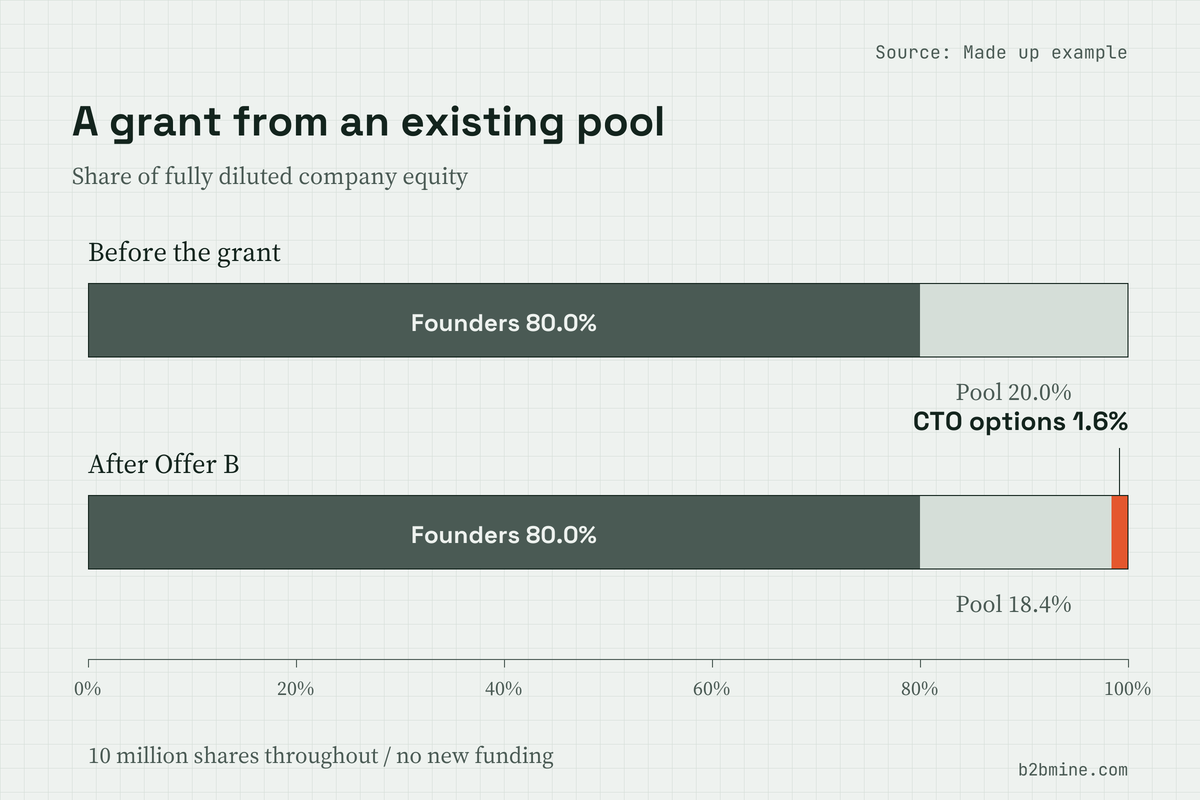
Say a made-up warehouse inspection software company has 10 million fully diluted shares. Its founders hold 8 million, and its reserved employee pool holds 2 million.
It compares two CTO offers with a $2 option purchase price and a 4-year schedule.
Offer A pays $170,000 a year and grants 80,000 options. Offer B pays $150,000 and grants 160,000 options. Both grants come from the existing pool.
Offer A covers 80,000 shares out of 10 million.
The CTO's share is 0.8%.
Offer B covers 160,000 shares out of the same 10 million.
The CTO's share is 1.6%.
The table shows the fully diluted allocation before the grant and after Offer B. The CTO column counts shares covered by options, which remain unexercised.
Holder | Shares before | Share of company before | Shares after | Share of company after |
|---|---|---|---|---|
Founders | 8,000,000 | 80.0% | 8,000,000 | 80.0% |
Reserved employee pool | 2,000,000 | 20.0% | 1,840,000 | 18.4% |
CTO options | 0 | 0.0% | 160,000 | 1.6% |
Total | 10,000,000 | 100.0% | 10,000,000 | 100.0% |
Offer B cuts annual salary by $20,000.
Over the assumed 4 years, the CTO gives up $80,000.
The CTO receives 80,000 extra options in return.
Dividing the lost $80,000 salary by those extra options gives $1 each.
Each extra option would need to produce that $1 after its purchase cost.
Adding the $2 purchase price gives $3 per common share.
At that payout, Offer B's extra options would cover the lost salary before tax. The comparison assumes full vesting, no further dilution, and a sale paying that amount to common shareholders.
It leaves out payment timing and the chance of receiving nothing.
The total purchase cost also changes. Offer A costs $160,000 to exercise in full. Offer B costs $320,000. A larger grant can therefore require more cash before any sale.
Write down the cash pay, share count and grant terms in your own offer. Then compare them with the questions in negotiating the full equity offer.
Use these figures as a starting point, then ask a startup lawyer about your own deal.