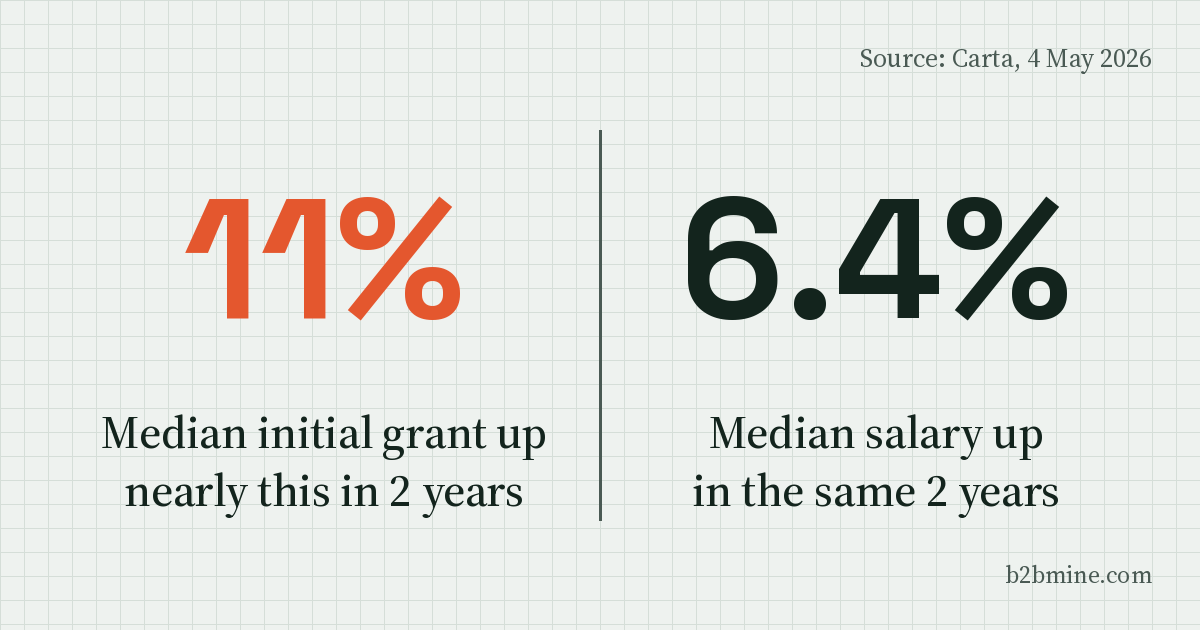
Among startups on Carta, the median initial equity grant for individual contributors rose nearly 11% in two years, while the median salary rose 6.4%, according to a report published on 4 May 2026.
The options in an offer are the part to push on, because the board sets the strike price at or above the latest 409A value, per Carta guidance from 4 August 2026.
The strike price rule covers US companies.
An offer pays you the gap between the sale price and your strike price, for each option you hold.
So the number of options and the terms around them are what you can ask to change.
Strike price: at or above the 409A value
The board approves each new 409A value before the company grants options at that price. A founder's guide to the 409A valuation was published by Carta on 4 August 2026.
It says new grants must be priced at or above the most recent 409A value.
A request for a lower strike price has little to stand on. Ask what the strike price is and which 409A value set it.
Ask when that value was set. Carta says a new one follows a priced round, a SAFE, or a convertible note, and grants made after that use it.
A later grant at $1.80 would cost $54,000 for 30,000 options, which is $18,000 more than at $1.20.
Options: 30,000 offered, 45,000 asked
Say a made-up clinic scheduling software company offers you 30,000 options at a strike price of $1.20. The company has 6,000,000 shares in all.
Startup Equity Calculator: How to Value Startup Equity was published by Carta on 13 January 2025. It says to divide your options by all the shares the company has issued, preferred shares included.
Your 30,000 options divided by 6,000,000 shares is 0.5%.
Carta's median grant for a first engineer is 1.54%, per data from 10 December 2025, and grants fall with each later hire.
The post on grants by hire number has the figures.
Say you ask for 45,000 options. 45,000 divided by 6,000,000 is 0.75%.
At $1.20 each, exercising 30,000 options costs $36,000. Exercising 45,000 options costs $54,000.
Now say the company sells for a made-up $60 million. Each share gets $10.00, which is $60,000,000 divided by 6,000,000.
Each option keeps $8.80, which is $10.00 minus $1.20.
30,000 options keep $264,000, and 45,000 options keep $396,000. The extra 15,000 options add $132,000.
The table shows both offers side by side.
Offer | Options | Share of company | Cost to buy | Kept at $10.00 a share |
|---|---|---|---|---|
Offered | 30,000 | 0.5% | $36,000 | $264,000 |
Asked | 45,000 | 0.75% | $54,000 | $396,000 |
Both sums give every share the same price and leave out later rounds, preferred stock and tax.
Short answers to nearby questions:
Question | Short answer |
|---|---|
Can you negotiate the strike price? | A lower one is not on offer. The board sets it at or above the latest 409A value (Carta, 4 August 2026). |
How much equity should you ask for? | Start from the benchmark: a first engineer's median grant is 1.54% (Carta, 10 December 2025). |
Is 1% equity in a startup good? | It sits below the 1.54% first engineer median (Carta, 10 December 2025). |
What is a standard vesting schedule? | 4 years with a 1-year cliff (Carta, 29 July 2026). |
Which acceleration is more common? | Double trigger, according to Carta (29 July 2026). |
How long do you have to exercise after leaving? | Usually 3 months, according to Carta (18 April 2023). |
How do you work out your share of the company? | Divide your options by all issued shares, including preferred shares (Carta, 13 January 2025). |
Is a grant taxed when you receive it? | Not for most options (IRS Topic 427, reviewed 24 September 2026). |
How fast are grants rising for AI and ML engineers? | The median initial grant rose 31% from January 2024 to February 2026 (Carta, 4 May 2026). |
Salary: $9,000 a year given up for 15,000 options
Salary and options can trade against each other. For AI and ML engineers, Carta's median initial grant rose 31% from January 2024 to February 2026, against 9.1% for salary.
At companies valued between $1 million and $10 million, that grant rose 64% in two years, and between $10 million and $25 million it rose 52%.
Say the company asks for $9,000 less salary each year for the extra 15,000 options. Over 4 years, that is $36,000.
Each extra option must gain at least $2.40 to cover it, which is $36,000 divided by 15,000.
A $2.40 gain plus the $1.20 strike price is a sale price of $3.60 a share. At 6,000,000 shares, that is a $21.6 million sale.
Below $3.60 a share, the salary you gave up is worth more. At $2.00 a share, the extra options keep $12,000. At $10.00 a share, they keep $132,000.
Vesting: 4 years with a 1-year cliff
Vesting Explained: Schedules, Cliffs, Acceleration, and Types was published by Carta on 29 July 2026. It calls 4 years with a 1-year cliff the standard schedule.
A quarter of the grant vests at the cliff, and the rest vests each month after.
In the example, 7,500 of the 30,000 options vest at the cliff. The other 22,500 vest at 625 per month over the next 36 months.
Ask whether the grant speeds up when the company is bought. Single trigger vests everything after a sale.
Double trigger needs a sale and then a firing without cause.
Carta says double trigger is the more common of the two.
Exercise window: 90 days after you leave
The Post Termination Exercise Period (PTEP) for Options Explained was published by Carta on 18 April 2023. It says employees usually have 3 months after leaving to exercise vested options.
Options left unexercised go back to the company's pool.
Say you leave after 2 years in the example. 15,000 options have vested by then, and exercising them costs $18,000.
That cost falls due inside the window. Carta adds that an incentive stock option keeps its tax treatment for only 3 months after employment ends.
Exercised later, it is taxed like a nonstatutory option.
Ask for a longer window in writing.
Your offer: four numbers to write down
Copy these four lines and fill them in:
Options offered: ______ options
All shares in the company: ______ shares
Your strike price: $______ for each share
Your exercise window after you leave: ______ days
In the example, the lines read 30,000 options, 6,000,000 shares, $1.20, and 90 days.
Four conditions change it:
you join as the fifth hire, not the first: Carta puts the first hire's median grant at roughly 1% to 1.5% and the fifth at roughly 0.31% to 0.34% (hires made in 2023, published 13 March 2024).
The company raises another round: the same 45,000 options become a smaller share, because each round adds shares. Carta data from 10 July 2026 puts the median seed and Series A at 18% each.
More round-by-round figures sit under grants and rounds.
The company is bought: the acceleration terms decide what happens to options that have not vested.
You leave early: the exercise window decides whether you can keep the options you vested.
Get these answered first:
How many shares does the company have in all?
What was the company's value after its last round?
When do the options vest, and is there a cliff?
How long do I have to exercise after I leave?
Does the company plan tender offers or refresh grants?
Bring your four numbers and these five questions to your next call, and ask for the final offer in writing.
Then work out what the final offer pays at a sale.
This is general information. Have a startup lawyer check your own papers before you sign.