Your startup options are worth the gap between the sale price and your strike price for each share you own.
The strike price starts at or above the company's latest 409A value, according to Carta guidance published on 4 August 2026.
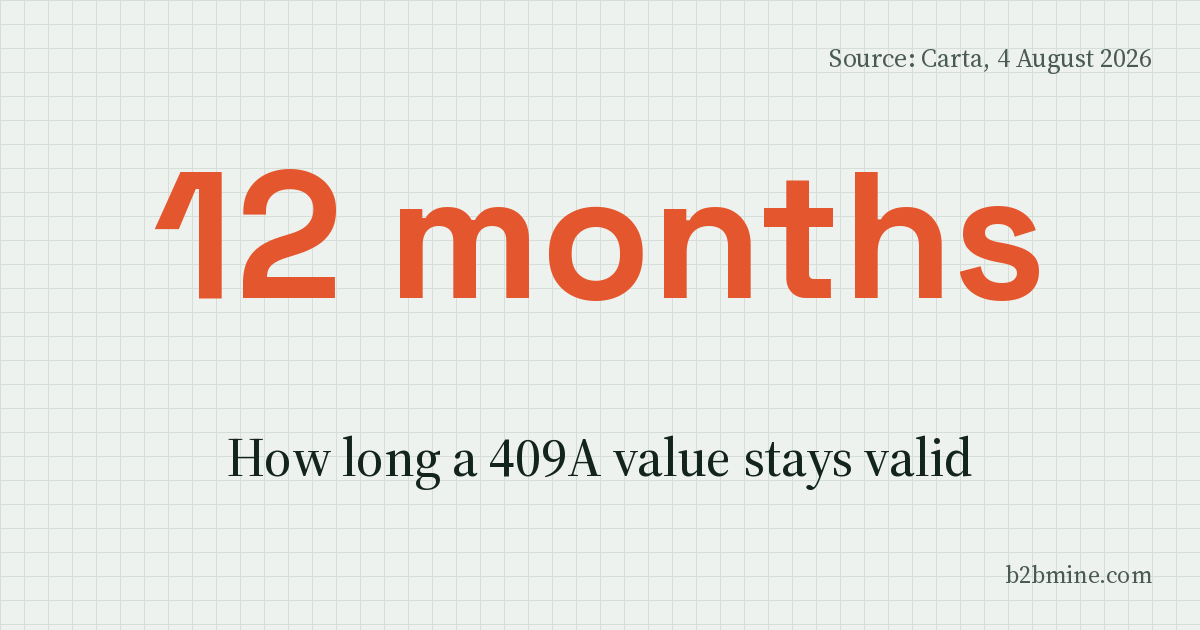
That value stays valid for up to 12 months or until a material event. The rule covers US companies.
Strike price and 409A value
The company's board sets the strike price. It approves the new 409A value before it grants options at that price.
A 409A value is not the price investors pay. Carta says it values common stock for tax purposes. A fundraising valuation sets the price investors pay for preferred stock, and it is usually higher.
A new 409A value follows a priced round, a SAFE, or a convertible note.
A credible term sheet to be acquired starts one too, and so does a major change in projections. Grants made after that use the new value.
A company needs a valuation before it issues its first options. Carta says it needs one at least every 12 months to keep issuing them.
The US rules in 26 CFR 1.409A-1 presume a valuation reasonable in one case. An independent appraisal dated no more than 12 months before the grant qualifies.
A value older than 12 months is not reasonable under the general rule in the same section.
That is the text on eCFR, current on 20 October 2026.
Short answers to nearby questions:
Question | Short answer |
|---|---|
Who sets the strike price? | The board, at or above the latest 409A value (Carta, 4 August 2026). |
How long does a 409A value last? | Up to 12 months, or until a material event (Carta, 4 August 2026). |
What starts a new 409A value? | A priced round, SAFE, convertible note or credible acquisition term sheet (Carta, 4 August 2026). |
Is the 409A value the price investors pay? | No. It is usually lower than the fundraising valuation (Carta, 4 August 2026). |
Does the US tax a grant? | Not for most options (IRS Topic 427, reviewed 24 September 2026). |
When are nonstatutory options taxed? | At exercise, on the stock's value minus what you paid (IRS Topic 427, 24 September 2026). |
What about incentive options? | No regular income at exercise, but alternative minimum tax may apply (IRS Topic 427, 24 September 2026). |
Does a new round change the strike price? | Grants after a priced round use the new 409A value (Carta, 4 August 2026). |
Shares and share of the company
Say a made up equipment rental software company offers you 44,000 options at a strike price of $2.00.
The company has 8,800,000 shares.
Your 44,000 options divided by 8,800,000 is 0.5%.
Cost and gain on a made-up sale
Buying your options costs $2.00 for each share. For 44,000 shares, that is $88,000.
Say a Series B then sells 12% of the company, the median in Carta data from 10 July 2026.
The company now has 10,000,000 shares.
Your 44,000 shares divided by 10,000,000 is 0.44%.
The table shows your share before and after the Series B.
Holder | Shares before | Share of company before | Shares after | Share of company after |
|---|---|---|---|---|
You | 44,000 | 0.5% | 44,000 | 0.4% |
Everyone else | 8,756,000 | 99.5% | 9,956,000 | 99.6% |
Total | 8,800,000 | 100.0% | 10,000,000 | 100.0% |
Now say the company sells for a made-up $90 million. Each share gets $9.00, which is $90,000,000 divided by 10,000,000.
Your 44,000 shares are worth $396,000 at that price.
Take away the $88,000 cost. You keep $308,000.
Now say the sale is smaller, at a made-up $40 million. Each share gets $4.00, which is $40,000,000 divided by 10,000,000.
Your 44,000 shares are worth $176,000 at that price. Take away the $88,000 cost. You keep $88,000.
Both sums are before tax and give every share the same price.
Preferred and common stock are different, as Carta's guide shows with its two values.
A later round would shrink your share again.
Round price and strike price
Say investors paid a made-up $5.00 for each preferred share in the last round. The 409A value is usually lower, according to Carta, so say it is $2.00.
A new grant must be priced at or above $2.00, not the $5.00 investors paid.
At a $9.00 sale price, a $2.00 strike price leaves $7.00 on each share. Priced at $5.00, it would leave $4.00.
Early grant and later grant
Now compare two grants of 44,000 options each. One came before a priced round, and the other came after.
The early grant has a strike price of $2.00. A priced round then sets a new 409A value. The later grant has a made-up strike price of $3.50.
The later grant costs $154,000 to buy: 44,000 shares at $3.50 each.
At the same $9.00 sale price, the later grant is worth $396,000 minus $154,000. That is $242,000.
The early grant keeps $308,000, so the gap is $66,000.
The shares and the sale price are the same. The lower strike price leaves you with more.
More equity questions are answered under startup equity posts.
Tax and the price you pay
For US federal tax, IRS Topic 427 covers two types of options. It was reviewed on 24 September 2026.
Incentive options add no regular income at grant or at exercise. You may owe alternative minimum tax in the year you exercise.
Most nonstatutory options add no income at grant. At exercise, you include the stock's value minus the amount you paid as income.
At sale, gain or loss on the stock is generally a capital gain or loss, according to the same page.
If you miss the special holding period for an incentive option, the gain is ordinary income. Your employer should provide Form 3921 after you exercise an incentive option.
In the example, say you exercise at $9.00 for each share. The income is $9.00 minus $2.00, which is $7.00 for each share.
For 44,000 shares, that is $308,000. It matches the gain above.
Your shares and your sale price
Copy these four lines and fill them in:
Your options: ______ shares
All shares in the company: ______ shares
Your strike price: $______ for each share
The sale price: $______ for each share
In the example, the lines read 44,000 options, 8,800,000 shares, $2.00 and $9.00.
Divide your options by all shares to get your share. Subtract your strike price from the sale price. Then count that gap once for every option you hold.
Your figure goes up or down with:
the company's next 409A value, because a new priced round, SAFE or convertible note starts one.
the number of shares the company has, because every new round adds shares.
the type of option you hold, because US tax treats incentive and nonstatutory options differently.
when you leave, because options pay only after they vest and you exercise them.
Questions for your lawyer:
What is the strike price, and which 409A value set it?
How many shares does the company have in all?
Are the options incentive or nonstatutory?
Does the grant vest over 4 years with a 1 year cliff?
How long do you get to exercise after you leave?
Write down your option count, your strike price, and the company's share count, then run the steps above.
Then see how to ask for more. [ADD WHEN LIVE: how to negotiate equity in a startup]
Every deal is different. An accountant or startup lawyer should look at yours.