Whether 1% equity is a lot in a startup depends on your job and on how many rounds follow.
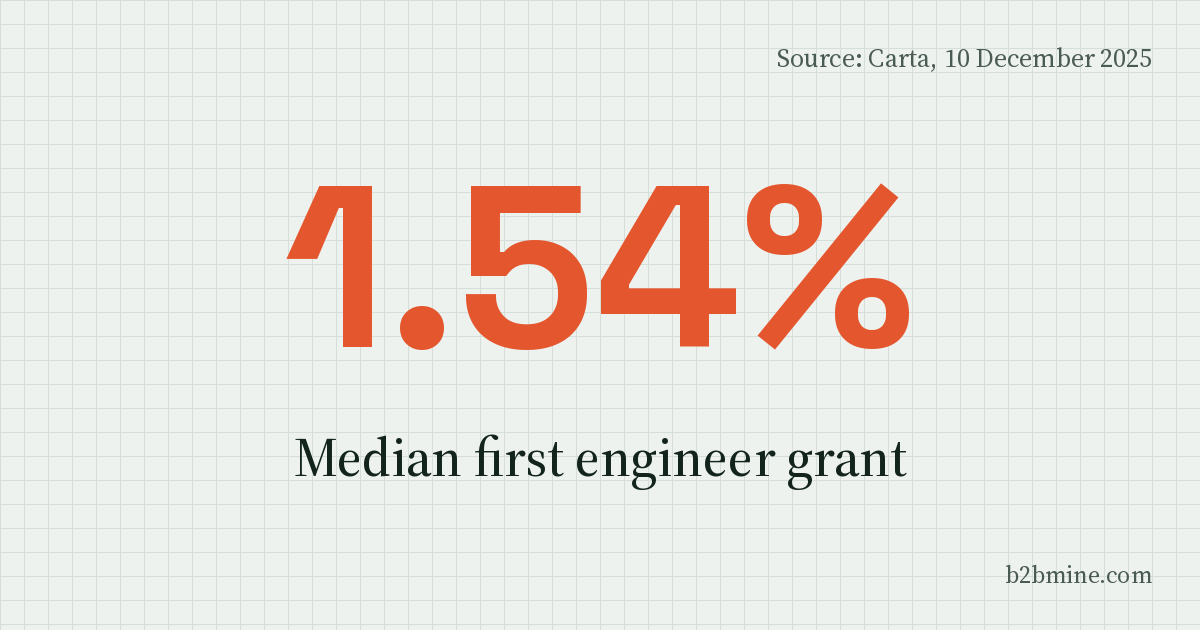
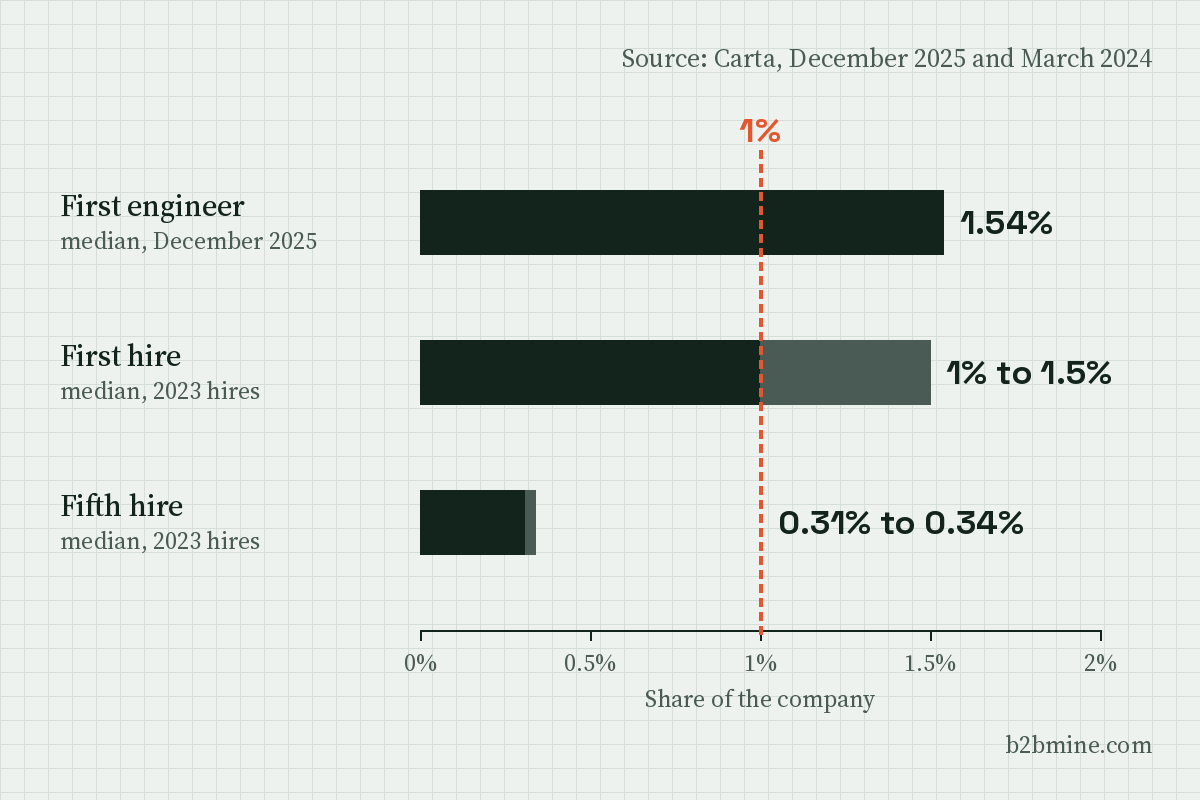
Among startups on Carta, a first engineer's median grant is 1.54% of the company, according to data published on 10 December 2025.
Carta data from 10 July 2026 put the median seed round and the median Series A at 18% each.
Those two rounds cut a 1% share to 0.67%.
Expect a different number if:
you are the first hire, not the fifth: the median grant is higher.
the company raises a seed round and a Series A: your share shrinks each time.
your 1% is stock options, not shares: you must buy them before they count.
You leave before a sale: you need cash to exercise your vested options.
If 1% is the offer for a first engineer
A first engineer's median grant is 1.54%. A 1% grant sits 0.54 points below it.
How Much Equity Do the First 5 Hires at a Startup Receive is a Carta page on nearly 5,000 US hires made in 2023.
It was published on 13 March 2024. Its median for the first hire is roughly 1% to 1.5%. So 1% sits at the low end of that range.
The two Carta pages cover different years and different hires, so their medians differ. Both put 1% at or below the middle.
The post on first engineer offers covers this role in more detail.
Short answers to nearby questions:
Question | Short answer |
|---|---|
Is 1% equity in a startup good? | It sits below the 1.54% first engineer median (Carta, December 2025) and above the 0.31% to 0.34% fifth hire median (Carta, March 2024). |
How much equity is good in a startup? | Roughly 1% to 1.5% for a first hire, and less for later hires (Carta, March 2024). |
If you are the fifth hire
The same Carta data put the fifth hire's median at roughly 0.31% to 0.34%. A 1% grant sits well above that range.
Carta says benchmarks for all five hires rose in 2023 compared with 2022.
Grants fall with each hire, from roughly 1% to 1.5% for the first to that range for the fifth. Only 7% of early hires held 5% or more.
If the company raises seed and Series A
Say a made-up warehouse scheduling software company has 8,405,000 shares. You hold 84,050 of them, which is 1% of the company.
The median seed and Series A each sell 18% of the company. That comes from VC Startup Fundraising Benchmarks From 1000 Rounds, posted on 10 July 2026.
The post covers over 1,000 software rounds from the last 6 months.
The seed round sells 18%. The company then has 10,250,000 shares, and the seed investor holds 1,845,000 of them.
Your 84,050 shares divided by 10,250,000 is 0.82%.
Series A sells another 18%. The company then has 12,500,000 shares, and the new investor holds 2,250,000 of them.
Your 84,050 shares divided by 12,500,000 is 0.67%.
Use your own numbers the same way: your shares divided by all shares, after each round.
The table shows your share before the seed round and after Series A.
Holder | Shares before | Share of company before | Shares after | Share of company after |
|---|---|---|---|---|
You | 84,050 | 1.0% | 84,050 | 0.7% |
Everyone else | 8,320,950 | 99.0% | 12,415,950 | 99.3% |
Total | 8,405,000 | 100.0% | 12,500,000 | 100.0% |
Now say the company sells for a made-up $100 million after Series A.
Each share gets $8.00, which is $100,000,000 divided by 12,500,000.
Your 84,050 shares pay $672,400. A flat 1% of $100 million is $1,000,000.
The sum leaves out the price of buying your shares and any tax.
Later rounds sell less. The same post puts the median Series B at 12% and the median Series C under 10%.
A Series B that sells 12% takes your 0.67% to 0.59%.
Round by round numbers for founders are under startup equity.
If you leave before the company sells
If your 1% is stock options, it turns into shares only when you buy them. Your grant letter shows whether the 1% is options or shares.
The strike price sets what each share costs you.
Startup Employees Are Saying No to Their Vested Equity was published on 16 December 2024. Its Carta data show employees exercised 33% of vested options whose shares had gained value.
The page names two hurdles for options: vesting and exercise.
Voting is another gap. Real Startup Ownership Data Founders Employees and Investors was published on 22 January 2025. It says employees often cannot vote until they vest and exercise their options.
Founders who own under 50% do not always lose control to investors.
Carta calls a 4-year schedule with a 1-year cliff the standard, in its data on hires made in 2023.
Run the seed and Series A steps above with your own share count and your own grant.
Then work out what a grant with a strike price is worth.
Nothing here is legal or tax advice. A lawyer who works with startups can check your case.