Section 142 of the Delaware General Corporation Law leaves officer titles to a company's bylaws or its board, and it never uses the word founder or cofounder.
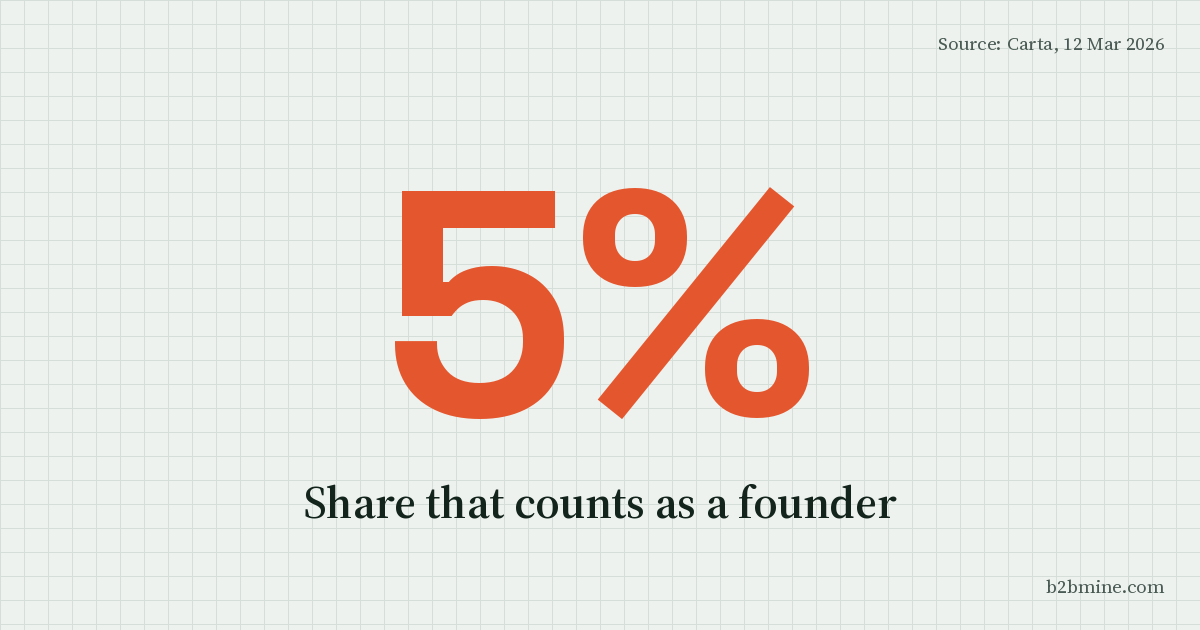
In its Founder Ownership Report of 12 March 2026, Carta counts a person as a founder at 5% or more of a US company before any venture round.
So neither word gives a right on its own. Your shares, your office, and your vesting terms do.
Four parts of a company's papers set the two words apart: the title, the share count, the split, and the tax filing. Each section below takes one.
A made-up veterinary clinic billing software company, with 10,000,000 shares, runs through them.
Titles and offices
A title is a choice the company makes. Section 142(a) says each officer holds the titles and duties stated in the bylaws or in a board resolution.
The same subsection lets one person hold several offices.
Any number of offices may be held by the same person
Delaware General Corporation Law, Title 8, Section 142(a), as posted by the State of Delaware on Delaware Code Online.
The sentence goes on to say the certificate of incorporation or the bylaws can limit this.
So one cofounder can be CEO while another is CTO, and one founder can hold both offices. The section asks for one duty by name.
One officer must record the proceedings of stockholder and director meetings.
An office can also end. Under Section 142(b), an officer holds the office until a successor is elected, or until the officer resigns or is removed.
An officer may resign on written notice. Under Section 142(e), the bylaws say who fills the vacancy, and the board fills it if the bylaws are silent.
Section 142(d) adds that a failure to elect officers does not dissolve the corporation.
Founder and cofounder are not offices in the section. The section also says nothing about who owns shares.
That is why the two papers matter: the bylaws or board resolutions for the officers, and the stock records for the shares.
Founders and first hires
Carta's test for a founder is a share test with three parts. The holder is an individual and not a fund. The company is incorporated in the US. The holder held at least 5% before any venture round.
The data is a snapshot of 1 January 2026 across more than 50,000 mostly venture-backed companies, per Carta's report of 12 March 2026.
On the made-up company's 10,000,000 shares, 5% is 500,000 shares. A person who holds 450,000 shares before any venture round holds 4.5%.
That is under the line, so Carta's data would not count the person as a founder.
A first hire sits below that line too. Carta's State of Startup Compensation: H1 2026 of 28 October 2026 puts the median first hire's starting grant at 1.75% of the company over the past two years.
Carta says the figure keeps climbing from earlier analyses. On 10,000,000 shares, 1.75% is 175,000 shares.
The 75th percentile grant is 4.26%, or 426,000 shares. Even that grant sits under the 5% line.
Grants by job level are covered across the full list of equity posts.
Short answers to nearby questions:
Question | Short answer |
|---|---|
Are founder and cofounder the same? | In daily use, yes: a company started by two people has two founders. Delaware law gives neither word a legal status (Section 142). |
Which is bigger, founder or cofounder? | Neither. Rank comes from an office such as CEO, which the bylaws or the board set (Delaware Section 142). |
Co-founder or CEO, which is higher? | The CEO holds an office the board can fill. Cofounder is not an office in Delaware Section 142. |
Can a company have a founder and a cofounder? | Yes. Delaware law leaves titles to the company's bylaws or board resolutions (Section 142). |
Is it correct to say cofounded? | Yes, for a company that two or more people started together. |
What percent makes someone a founder? | Carta counts 5% or more before venture funding, for US companies (12 March 2026). Delaware law sets no percent. |
How much does each founder usually hold? | The median two-founder split for teams formed in 2025 was 51 to 49 (Carta, 18 June 2026). |
How soon must a vesting share election be filed? | Within 30 days after the shares are transferred (IRS Form 15620, revised April 2025). |
One founder and two founders
Solo founders started 36% of new companies on Carta in 2025, up from 31% in 2024, per its report of 12 March 2026.
Two founder teams closed 36% of the rounds on Carta that year, and solo founders closed 20%, per Carta's data of 18 June 2026.
In SaaS, 40% of the startups that closed rounds had two founders, per the report of 12 March 2026.
Take the made-up company. An investor buys 20% of it in a round.
The 10,000,000 shares that exist today will be 80% of the company after the round.
10,000,000 divided by 80% is 12,500,000 shares in total.
The company issues 2,500,000 new shares to the investor.
On path one, a single founder holds all 10,000,000 shares. After the round, the founder holds 80.0% of the company.
On path two, two cofounders hold 5,100,000 and 4,900,000 shares, a 51-to-49 split.
That matches the median split for two founder teams formed in 2025, per Carta's data of 18 June 2026. This table shows path two before and after the round.
Holder | Shares before | Share of company before | Shares after | Share of company after |
|---|---|---|---|---|
First cofounder | 5,100,000 | 51.0% | 5,100,000 | 40.8% |
Second cofounder | 4,900,000 | 49.0% | 4,900,000 | 39.2% |
Investor | 0 | 0.0% | 2,500,000 | 20.0% |
Total | 10,000,000 | 100.0% | 12,500,000 | 100.0% |
The two cofounders hold 80.0% between them, the same total the single founder holds on path one. An equal split of 5,000,000 shares each would leave 40.0% each.
The round takes the same 20% on either path. Only the number of people who share the other 80% changes.
The founders' post lays out the usual two-founder split by year.
On path three, three cofounders hold 4,000,000, 3,000,000, and 3,000,000 shares.
The lead founder holds 10 points more than the next founder. Carta finds that gap at the median for teams of three to five. After the round, they hold 32.0%, 24.0%, and 24.0%.
Now give Path Two a first hire. The company grants 220,000 shares, close to the median first hire grant. That makes 12,720,000 shares in total.
220,000 divided by 12,720,000 is 1.7%.
The first cofounder now holds 40.1% and the second holds 38.5%. The investor holds 19.7%. The first hire holds a small stake next to either cofounder, and each cofounder gives up about 0.7 points to pay for it.
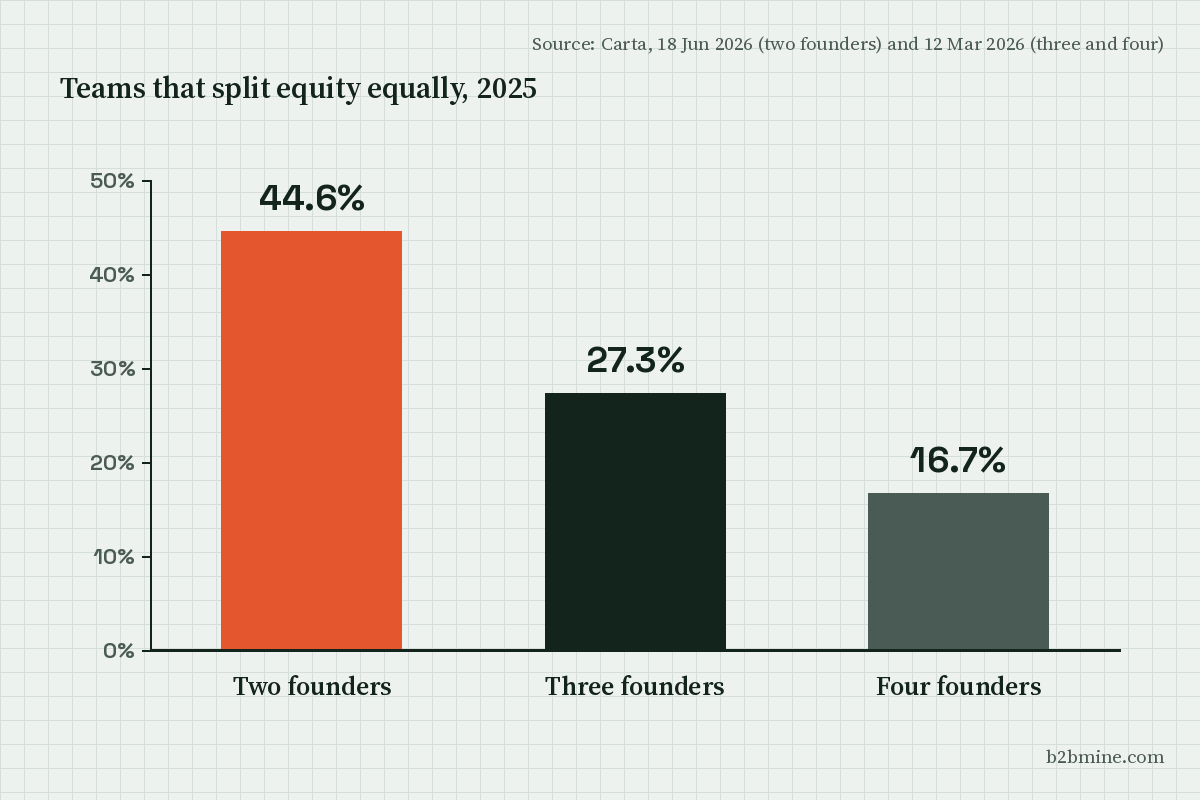
Equal splits get less common as teams grow. Carta puts the share of teams that split equally in 2025 at 44.6% for two founders (18 June 2026), 27.3% for three and 16.7% for four (12 March 2026).
Check these before you use the number:
Team size: with three to five founders, the lead founder usually holds at least 10 points more than the next founder (Carta, 18 June 2026).
Sector: the lead founder of a typical two-founder biotech team holds 58% (Carta, 18 June 2026).
Round size: if the investor buys 25% instead of 20%, the two cofounders hold 75.0% between them.
State of incorporation: Section 142 covers corporations organized under Delaware's chapter, so another state's law and your own bylaws can differ.
Vesting and the 30-day filing
Shares that vest are shares a person can lose. IRS Form 15620 covers an election under Section 83(b) for shares given for work while they can still be forfeited, such as shares that vest over time. This is US federal tax.
no later than 30 days after the date the property was transferred
IRS Form 15620, Section 83(b) Election, revised April 2025. The person who did the work gives a copy to the company.
Say the company issues vesting shares to a founder on 10 March 2027. The 30th day after that is 9 April 2027, a Friday.
Say the shares were issued on 11 March 2027 instead. The 30th day is 10 April 2027, a Saturday. The form counts the election as timely if it is postmarked by the next business day, which is Monday 12 April 2027.
A first hire who receives vesting shares runs on the same clock. The title on the card does not change the date. The election is the person's own choice, so a tax adviser can say whether it fits.
Questions for your lawyer:
Which paper names each officer, and who can change a title?
How many shares does each founder hold, and how many of them vest?
On what date did each founder's shares transfer, and was the 30 day filing made?
Does anything in the bylaws limit one person to one office?
Open your bylaws and your stock records and list each founder's office, share count and vesting terms on one page. Then read what a cofounder keeps after a break.
Nothing here is legal or tax advice. A lawyer who works with startups can check your case.