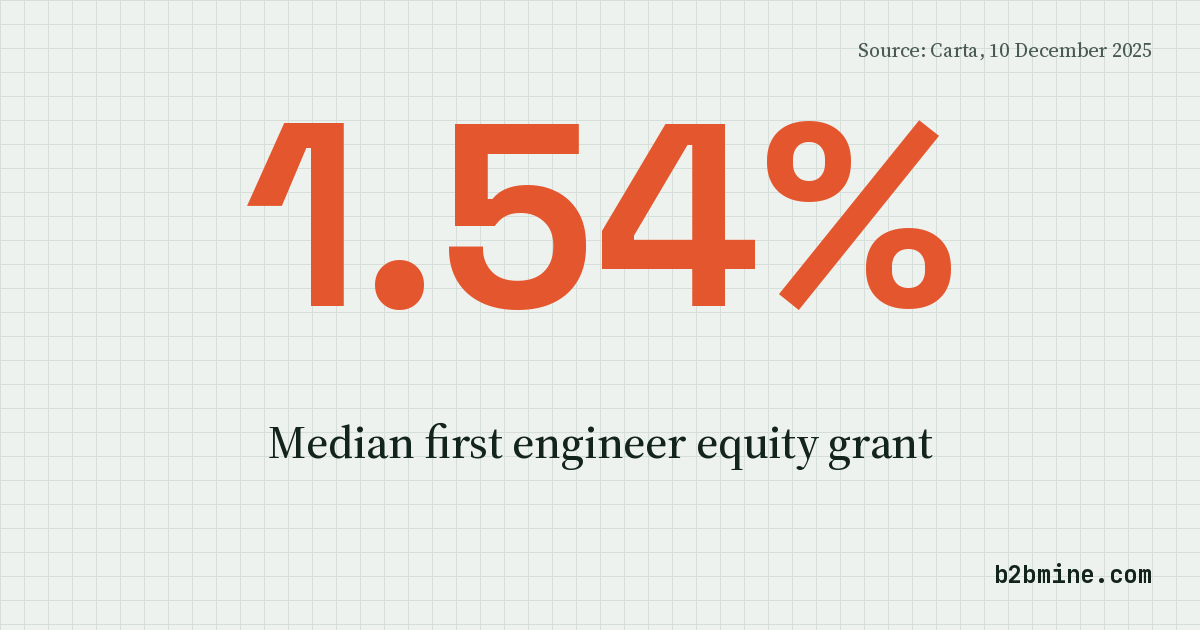
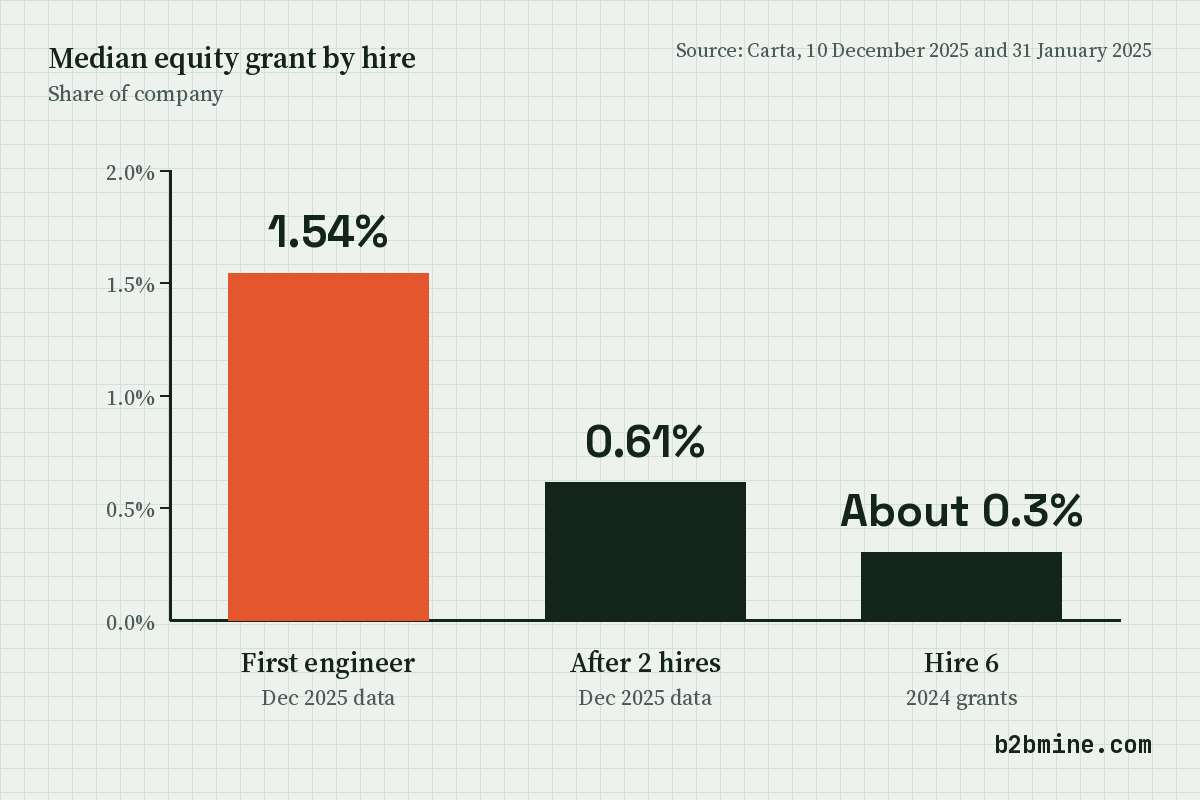
Your first engineer gets a median of 1.54% of the company, according to Carta data published on 10 December 2025.
It covers first engineers at tech startups over the two years before that date. Carta says a 1% offer sits below the middle of the market.
Check these before you use the number:
If the grant vests over 4 years with a 1-year cliff, the percentage covers all 4 years. Carta says that schedule is almost always used (10 December 2025).
Its 1.5% first-hire median for 2024 grants is also the full 4-year amount, per the Carta open forum (31 January 2025).
If the engineer builds AI or ML, the median grant for that group has climbed. Carta's State of Startup Compensation report for H2 2025, published on 4 May 2026, shows a 31% rise in the median initial grant for AI and ML engineers between January 2024 and February 2026.
If you grant incentive stock options, the engineer generally has no US federal taxable income at grant or exercise. IRS Topic 427, reviewed on 24 September 2026, adds that alternative minimum tax may apply in the exercise year, and a sale of the stock creates taxable income or a loss.
If you hand over real shares that vest over time, the engineer has 30 days from the transfer to file a US federal 83(b) election with the IRS.
IRS Form 15620, April 2025 revision, states the deadline and says only the IRS can consent to revoking the election.
Founding engineer equity: 1.54% at the median
A quarter of grants fall at or below 0.61% in Carta's data. The summary line of that page gives the top of the middle range as 3.5%.
The text of the same page gives 4.13%. Carta adds that roughly 70% of first hires at tech startups are engineers.
Carta's Peter Walker names early exercise and restricted stock awards as ways to add value beyond the percentage itself.
Short answers to questions:
Question | Short answer |
|---|---|
What is the typical equity range for founding engineers? | The median is 1.54%, and the middle half starts at 0.61% (Carta, 10 December 2025). |
Is 1% enough for a founding engineer? | It sits below the 1.54% median, according to Carta (10 December 2025). |
How much equity do the first five hires get in total? | 3.62% when every hire lands at the median (Carta, 2024 grants, published 31 January 2025). |
Do 10 hires use more than 5% of the company? | Many companies get through 10 hires under 5% (Carta, 31 January 2025). |
How long does a founding engineer's grant vest? | 4 years with a 1-year cliff in almost every case (Carta, 10 December 2025). |
Do cofounders split equity evenly? | Most three-founder teams do not. Carta says 27.3% split evenly last year, up from 21% the year before (report of 12 March 2026). |
Is the grant taxed when the engineer gets incentive stock options? | Generally, no income at grant or exercise for US federal tax. Alternative minimum tax may apply (IRS Topic 427, reviewed 24 September 2026). |
How long does the engineer have to file an 83(b) election? | 30 days after the transfer of the stock (IRS Form 15620, April 2025 revision). |
Later engineers: 0.61% after 2 hires
Grants fall fast after the first engineer. Carta's median drops from 1.54% to 0.61% after 2 hires (10 December 2025). By hire 6, grants for 2024 center near 0.3% (Carta open forum, 31 January 2025).
Carta calls the first hire a different conversation from every later hire.
First five hires: 3.62% of the company
A founder who hires 5 people at the median each time gives away 3.62% of the company in total. Carta reports that figure for 2024 grants (31 January 2025), drawn from more than 9,000 grants to the first 10 hires.
No founder hits the median every time. Many companies get through 10 hires without using 5% of the company.
Founders carve each grant out of their own stake, so see how much equity founders get.
After seed: founders keep about 56%
The Founder Ownership Report 2026, published on 12 March 2026, uses Carta data on rounds raised from 2021 through 2025.
After a seed round, the median founding team keeps about 56% of the company. At Series A, the median falls to 36%.
The median employee equity pool is 12.1% at seed. At Series C, the 16.8% pool outstrips the median founder ownership of 16.1%. Each round that sells shares cuts every holder's share, the engineer's grant included.
Say a made-up freight tracking software company has two founders. It grants its first engineer 1.5% of the company, then sells 20% in a seed round.
The company has 10,000,000 shares. The two founders hold 8,500,000, and the other 1,500,000 sit in the option pool.
The engineer gets 150,000 shares from the option pool. 1,500,000 minus 150,000 leaves 1,350,000 shares in the pool.
The engineer's grant is 1.5% of the company. 150,000 divided by 10,000,000 is 1.5%.
The seed investors buy 20% of the company after the round. The company issues 2,500,000 new shares for them.
The company now has 12,500,000 shares. 10,000,000 plus 2,500,000 is 12,500,000. The investors hold 20.0% because 2,500,000 divided by 12,500,000 is 20.0%.
The engineer still holds 150,000 shares. 150,000 divided by 12,500,000 is 1.2%.
The engineer's share fell by 0.3 percentage points, from 1.5% to 1.2%. The share count never changed.
Now say the grant sits at the 1.54% median instead. That is 154,000 shares, because 1.54% of 10,000,000 is 154,000. After the seed round, 154,000 divided by 12,500,000 is 1.23%.
The founders fell by 17.0 percentage points, from 85.0% to 68.0%. The option pool fell by 2.7 percentage points, from 13.5% to 10.8%. The table shows who holds what before and after the seed round.
Holder | Shares before | Share of company before | Shares after | Share of company after |
|---|---|---|---|---|
Two founders | 8,500,000 | 85.0% | 8,500,000 | 68.0% |
Founding engineer | 150,000 | 1.5% | 150,000 | 1.2% |
Option pool | 1,350,000 | 13.5% | 1,350,000 | 10.8% |
Seed investors | 0 | 0.0% | 2,500,000 | 20.0% |
Total | 10,000,000 | 100.0% | 12,500,000 | 100.0% |
Write down your share count, planned grant and seed sale, then run the example steps with them. Open the next page in this group for the seed and Series A dilution math.
Use these figures as a starting point, then ask a startup lawyer about your own deal.