Among software startups on Carta, the median seed round sold 18% of the company in the six months to 10 July 2026.
A holder with 10% before the round keeps 82% of that share afterward, so 10% becomes 8.2%.
An option pool added in the same round takes more, and the made-up company below shows by how much.
Share count and share of the company
Your share of the company is your shares divided by all shares. A round issues new shares, so the total grows and your share falls. Your share count stays the same.
Say a made-up two-founder school bus routing software company has 14,000,000 shares. The founders hold 13,000,000.
An early employee holds 140,000 options. The other 860,000 shares sit unissued in the option pool.
An investor offers $2 million at an $8 million pre-money value.
The company is worth $10 million after the money goes in. The investor owns $2 million out of $10 million. That is 20%.
The old holders keep the other 80%. Their 14,000,000 shares are 80% of the new total. The new total is 17,500,000 shares.
The investor gets 3,500,000 new shares.
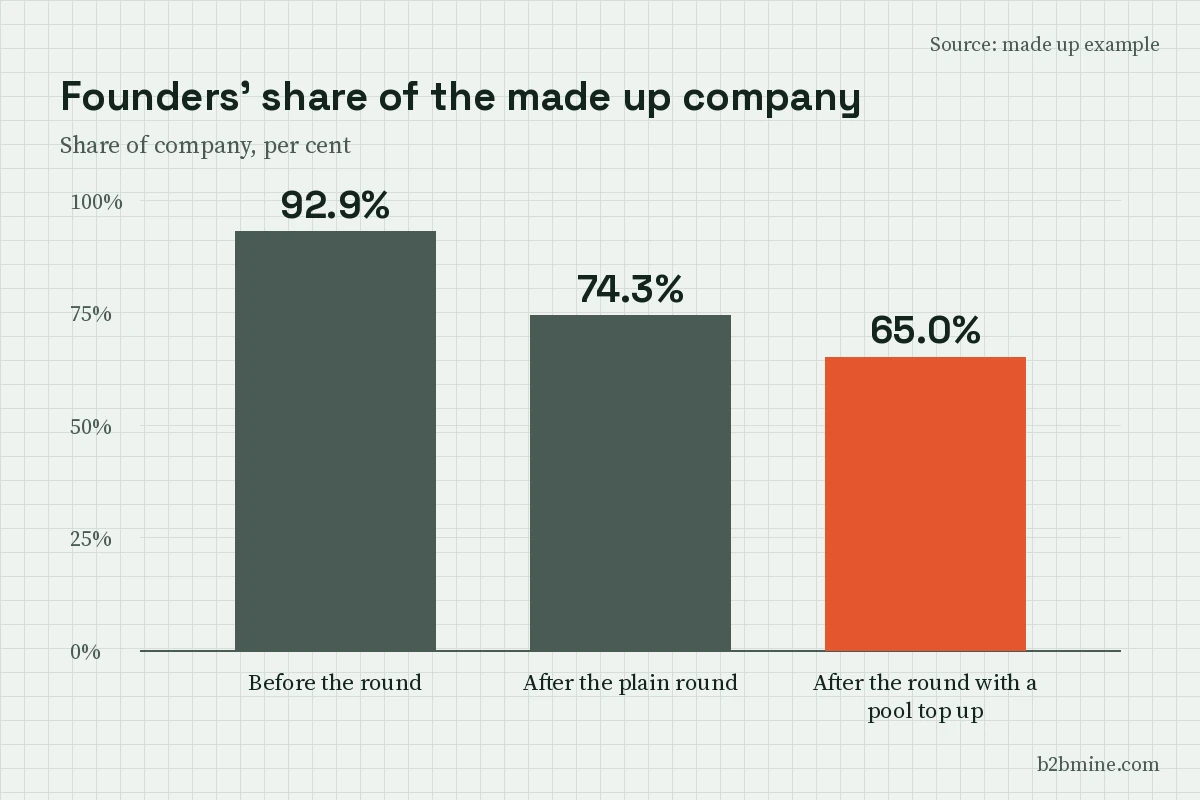
The founders hold 13,000,000 out of 17,500,000 shares. That is 74.3%, down from 92.9%.
This table shows the round with no change to the option pool.
Holder | Shares before | Share of company before | Shares after | Share of company after |
|---|---|---|---|---|
Founders | 13,000,000 | 92.9% | 13,000,000 | 74.3% |
Early employee options | 140,000 | 1.0% | 140,000 | 0.8% |
Unissued pool | 860,000 | 6.1% | 860,000 | 4.9% |
Investor | 0 | 0.0% | 3,500,000 | 20.0% |
Pool top-up and the price per share
Now the investor asks for a bigger option pool before the round closes. Granted options and unissued shares together must be 15% of the company after the round.
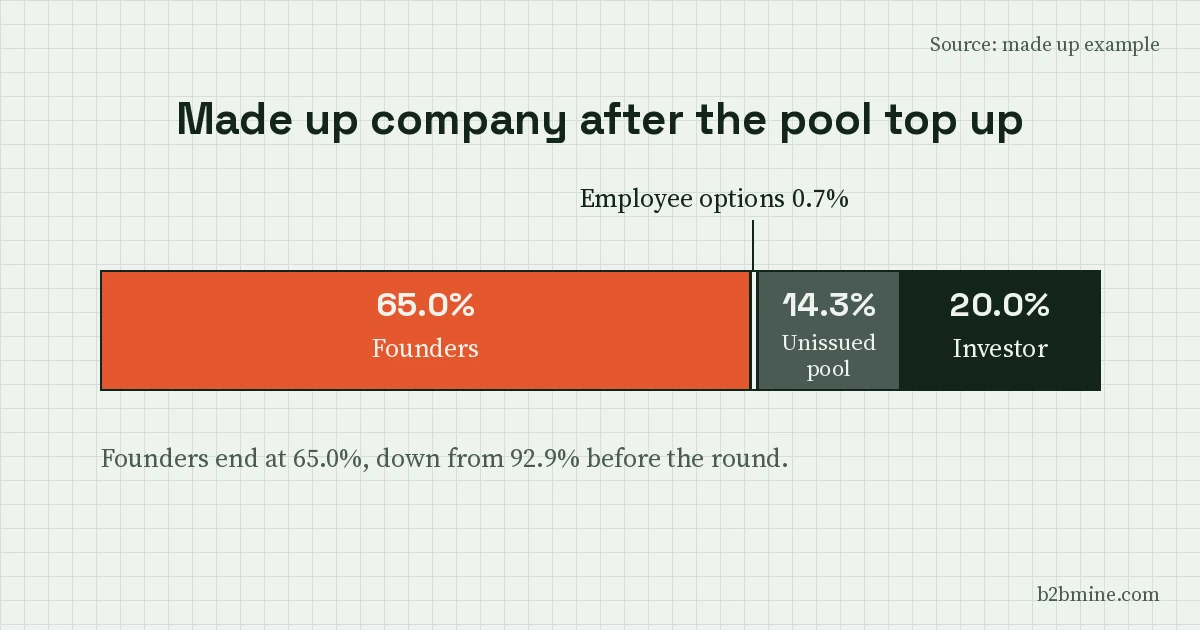
The investor still wants 20%, and the pool needs 15%, which leaves 65% for the founders.
The founders keep their 13,000,000 shares, so those shares must be 65% of the new total. 13,000,000 is 65% of 20,000,000.
The investor gets 4,000,000 of those 20,000,000 shares, which is 20%.
The pool holds 3,000,000 shares. That is 15%. It held 1,000,000 before, so 2,000,000 are new.
The company is worth $10 million after the round. $10 million divided by 20,000,000 shares is $0.50 a share.
This table shows the same round with the pool topped up to 15%.
Holder | Shares before | Share of company before | Shares after | Share of company after |
|---|---|---|---|---|
Founders | 13,000,000 | 92.9% | 13,000,000 | 65.0% |
Early employee options | 140,000 | 1.0% | 140,000 | 0.7% |
Unissued pool | 860,000 | 6.1% | 2,860,000 | 14.3% |
Investor | 0 | 0.0% | 4,000,000 | 20.0% |
The founders end at 65.0% with the new pool and at 74.3% without it. The pool costs them 9.3 points. The early employees' 140,000 options fall from 1.0% to 0.8% in the plain round and to 0.7% with the top up.
Short answers to nearby questions.
Question | Short answer |
|---|---|
How do you work out dilution? | Divide the shares you hold by all shares after the round. In the example, 13,000,000 of 17,500,000 shares is 74.3%. |
Does dilution cut the number of shares I own? | No. Your share count stays the same. Your share of the company falls because the total grows. |
How much does a seed round dilute? | The median software seed round on Carta sold 18% of the company in the six months to 10 July 2026. |
Who pays for a bigger option pool? | The holders from before the round. In the example, the founders end at 65.0% with the top-up and 74.3% without it. |
Do my options get diluted too? | Yes. The early employees' 140,000 options fall from 1.0% to 0.8%, or to 0.7% with the pool top-up. |
Do pre-money and post-money values change my share? | Yes. In the example, $2 million buys 20% on an $8 million pre-money value and 25% on an $8 million post-money value. |
Is dilution always bad? | Not by itself. Your share falls, and the round sets a new price per share. In the example, it is $0.50. |
Is dilution rising or falling? | Carta's report of 5 November 2026 says median dilution in new rounds keeps falling at every stage. |
Headline value and real value
Count the price next. Before the round, 14,000,000 shares at $0.50 are worth $7 million.
The investor called the company $8 million before the round. The gap is $1 million.
The 2,000,000 new pool shares at $0.50 each are worth $1 million.
So the old holders took a $7 million value, not the $8 million in the offer. They carry the cost of the new pool.
Carta's State of Private Markets: Q3 2026 came out on 5 November 2026. It reports higher median valuations at every stage in 2026 than in 2025.
The stage-by-stage figures sit in founder shares after each round.
Pool before the round and pool after it
The order of the steps changes who pays. Say the investor takes the plain 3,500,000 shares first, and the company adds the 2,000,000 pool shares after the round closes.
The new total is 17,500,000 plus 2,000,000. That is 19,500,000 shares.
The founders hold 13,000,000 of them, or 66.7%. The investor holds 3,500,000, or 17.9%.
With the pool added before the round, the founders held 65.0% and the investor 20.0%. Adding the pool after the round leaves the investor at 17.9%. The founders gain 1.7 points, from 65.0% to 66.7%.
An offer that adds the pool first gives the investor the full 20%. Check the order in the offer.
Series A and Series B on the same shares
The next rounds cut every holder again. Say the made up company sells 18% at Series A and 12% at Series B.
Those are the medians Carta reports for software rounds in the six months to 10 July 2026.
A round that sells 18% leaves every old holder with 82% of the share it held. A round that sells 12% leaves 88%.
The founders start at 65.0% after the seed round. 82% of 65.0% is 53.3% after Series A. 88% of 53.3% is 46.9% after Series B.
The seed investor goes from 20.0% to 16.4% to 14.4%. The unissued pool goes from 14.3% to 11.7% to 10.3%.
The early employee still holds 140,000 options. That is 0.7% after the seed round, 0.6% after Series A and 0.5% after Series B.
SAFE discount and shares issued
Say a made-up $500,000 SAFE converts in the seed round at the round price of $0.50. $500,000 divided by $0.50 is 1,000,000 shares.
With a 20% discount, the price is $0.40. $500,000 divided by $0.40 is 1,250,000 shares.
The discount adds 250,000 shares. They come out of every holder's share, the same way the investor's new shares do.
Pre-money value and post-money value
The same $8 million can be counted two ways.
As a pre-money value, the investor's $2 million buys $2 million out of $10 million. That is 20%.
As a post-money value, the same $2 million buys $2 million out of $8 million. That is 25%, so the old holders keep 75%.
Check which one the offer uses before you compare two offers.
Your shares and your round
Write these four lines down and work through the same steps with your own numbers. The startup equity section has stage figures to compare against.
Shares you hold: ______
All shares before the round: ______
New shares in the round, pool shares included: ______
Your share after the round: line 1 divided by the sum of line 2 and line 3: ______
The early employee in the plain seed round would write 140,000 on line 1, 14,000,000 on line 2 and 3,500,000 on line 3. 140,000 divided by 17,500,000 is 0.8%.
Your figure goes up or down with:
Round size: at the Carta median of 18%, a 5.0% stake falls to 4.1%.
Pool size: a 15% pool took 9.3 points from the founders in the example. A pool left at its old size takes none of those points.
Pre money or post money: the example moves the investor from 20% to 25%.
SAFE discount: a 20% discount added 250,000 shares in the example.
Compare your share before the round with your share after it, using the four lines above. Then open turning your share into sale money.
Nothing here is legal or tax advice. A lawyer who works with startups can check your case.