If you hold vested options in a private startup, you can sell only after you exercise them, and the company often has to approve the sale and the buyer, according to a Carta page published on 20 July 2022.
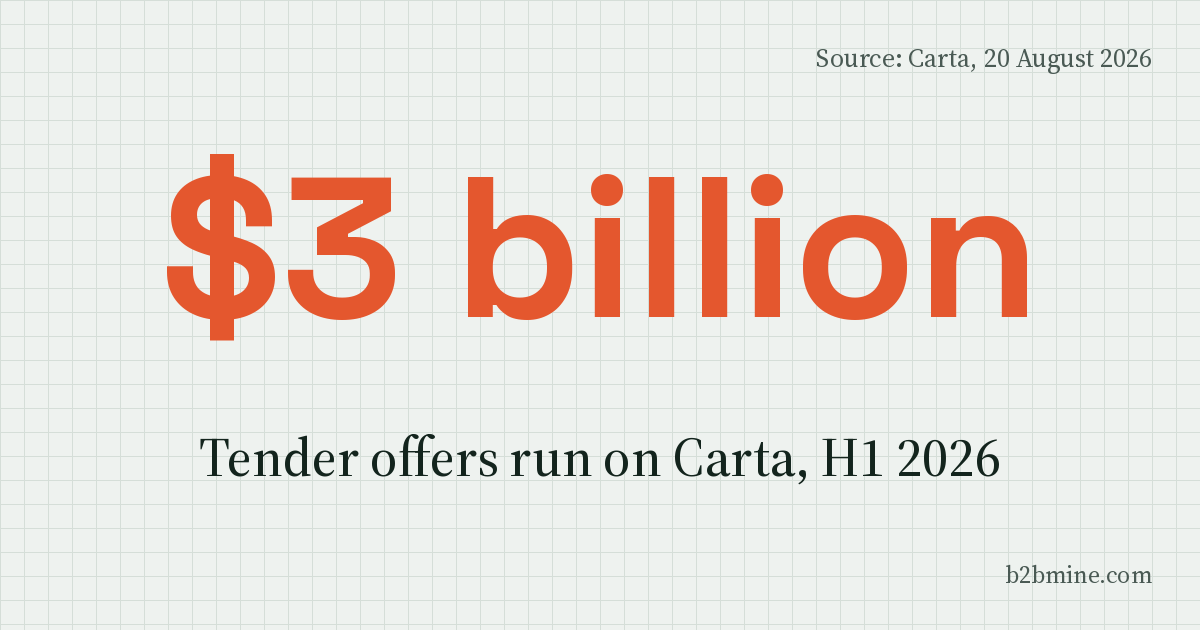
Carta administered 71 tender offers in the first half of 2026, worth about $3 billion, the highest first-half figures in at least six years, per its data from 20 August 2026.
Which route you get depends on the company: it can run a tender offer, buy your shares itself, or refuse a private sale.
Check these before you use the number:
Your company runs no tender offer: a private sale then needs the company's approval, and the company usually holds a right of first refusal (Carta, 20 July 2022).
You have left the company: in the median tender on Carta over three and a half years, no former employees were eligible to sell (Carta, 20 August 2026).
Your grant is in options, not shares: you buy the shares first, and the strike price sets the cost. The post on leaving before a sale gives Carta's 33% exercise rate for vested options that had gained value.
You exercised under a year ago: the gain counts as short-term for US tax, and the SEC holding period for restricted shares of a company that does not report to it is one year (IRS Topic 409, eCFR).
Nearly 70% of tenders come from Series C or later
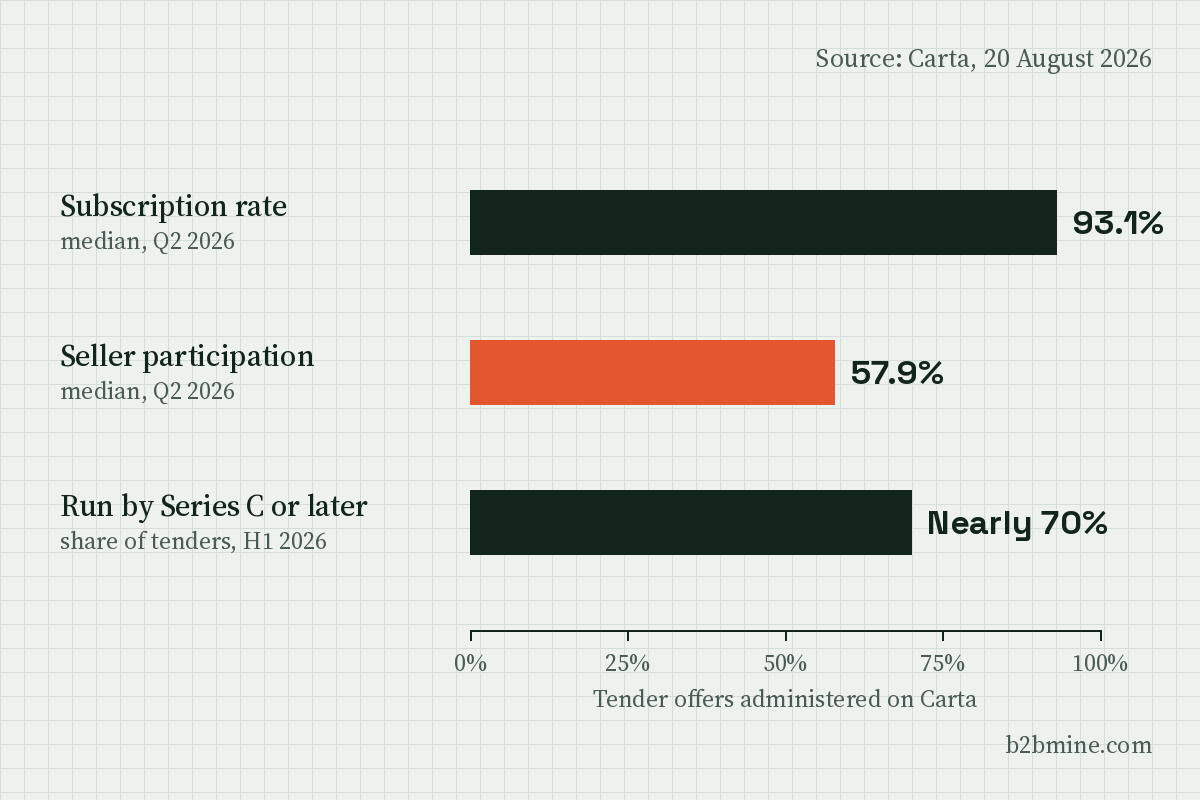
Nearly 70% of the tender offers Carta administered in the first half of 2026 came from companies at Series C or later. Carta ties the growth in tender offers to a slow exit market that began in the second half of 2022.
Early-stage tenders grew in popularity in 2022 and 2023 before the market tilted back to later stages.
The median offering was $28.5 million at Series C and later, and $8.5 million from seed through Series B. Year over year, the count rose 34%, and the transaction value rose 200%.
A tender offer comes in two forms. In a stock buyback, the company buys the shares. In a secondary sale, an outside buyer does.
Carta says a larger share of current employees is eligible in a buyback than in a secondary sale.
For former employees, the picture differs. In the median tender over the past three and a half years, none were eligible to sell.
In the second quarter of 2026, the median subscription rate was 93.1%, and the median seller participation rate was 57.9%.
Carta says both were down slightly from the first quarter. The participation rate has risen by more than 20 percentage points since the first quarter of 2021.
The company does not have to run a tender offer at all, according to Carta's page of 20 July 2022.
That page adds that a tender offer must stay open for at least 20 business days, which is about four weeks.
The company can also back out at any time.
0% median discount on tender offers
Most tender prices land at or above the value the company reached in its last primary round, according to Carta's data from 20 August 2026.
Among tenders held at least a year after a primary round, the median discount was 0% in each of the last five half-years. In the first half of 2026, the 25th percentile was 0%, and the 75th percentile was 10%.
So at least a quarter of those tenders carried a double-digit discount.
A private sale through a marketplace has its own cost. How to Sell Private Company Stocks says a secondary marketplace sale can cost upwards of 5% of your gross proceeds, and that it takes a lot of time. .
It adds that the company often has to approve the sale and the buyer, and that you may be allowed to sell only a set number of shares.
If more shares are offered than the company will buy, the company may prioritize certain holders, such as current employees.
Short answers to nearby questions:
Question | Short answer |
|---|---|
Can I sell startup shares before an exit? | Yes, if the company allows it. It may hold a right of first refusal and must often approve the buyer (Carta, 20 July 2022). |
Do I have to exercise my options before I sell? | Yes. You can sell only shares you have bought by exercising options (Carta, 20 July 2022). |
If you cannot pay to exercise, the same page names two routes. Option lending gives you a loan to exercise, and a bank loan may carry personal recourse, which puts your own assets at risk if the stock falls. Other lenders may take a share of your stock at a liquidity event. If the company allows cashless exercise, the sale proceeds pay the exercise cost for the shares sold.
1 year: the tax line and the SEC line
For US tax, IRS Topic 409 says an asset held more than one year gives a long-term gain or loss. An asset held one year or less gives a short-term gain or loss.
The page was reviewed on 24 September 2026. It puts the long-term rates for tax year 2025 at 0%, 15% and 20%, depending on taxable income.
Topic no. 427, Stock options, was reviewed on 24 September 2026. For most nonstatutory options, there is no taxable event at grant. At exercise, you include the stock's value minus what you paid.
A sale of the stock is generally a capital gain or loss. Most capital sales are worked out on Form 8949 and summed up on Schedule D of Form 1040, per Topic 409.
For an incentive stock option, you may owe alternative minimum tax in the year you exercise. Missing the special holding period makes the gain ordinary income.
Carta says that if you exercise and sell in one transaction, you pay ordinary income tax on the gain.
The SEC line is separate. Under eCFR 17 CFR 230.144, restricted securities of a company that does not report to the SEC need a minimum of one year before resale. The text was current on 22 October 2026.
a minimum of one year must elapse
The line is from 17 CFR 230.144(d)(1)(ii), as eCFR printed it on 22 October 2026.
Your company's own rules can be stricter. Carta says eligibility may require that you held the shares for a set time after exercise.
$130,000 now or $230,000 later in a made-up sale
Say a made-up construction bidding software company lets you sell in a tender offer. You hold 10,000 vested options at a strike price of $2.00. The tender price is $15.00 per share.
The tender pays $15.00 for each of your 10,000 shares, which is $150,000.
At $2.00 each, exercising 10,000 options costs $20,000.
If the company allows cashless exercise, the sale proceeds pay that cost. You keep $130,000 before tax.
Now say the tender is oversubscribed, and the company buys only 60% of the shares you offer. That is 6,000 shares, and they pay $90,000.
Exercising those 6,000 options costs $12,000. You keep $78,000 before tax.
The other 4,000 options stay unexercised, according to Carta's page of 20 July 2022.
Now say you hold the options instead, and the company sells later. Each option then keeps the sale price minus $2.00.
The table shows both paths side by side.
Path | Sale price for each share | You keep before tax |
|---|---|---|
Tender offer now | $15.00 | $130,000 |
Later sale | $2.00 | $0 |
Later sale | $4.00 | $20,000 |
Later sale | $15.00 | $130,000 |
Later sale | $25.00 | $230,000 |
Holding pays more only if the later sale price beats $15.00 a share. Each extra $1.00 adds $10,000.
At $4.00 a share, holding keeps $20,000. At $2.00 a share or less, it keeps nothing.
The table leaves out tax and later rounds. Each round adds shares and cuts the price per share, as the other startup equity topics show.
Ask before you sign:
Does the company hold a right of first refusal on my shares?
Does the company need to approve the buyer?
How many shares am I allowed to sell?
Are former employees allowed to sell?
What fees come out of the proceeds?
Compare the tender price with your strike price, then work out the gap for each option you hold.
Then see how an option gain is worked out.
Nothing here is legal or tax advice. A lawyer who works with startups can check your case.