The Founder Institute's FAST agreement sets an advisor's share of the company by stage and by how much work the advisor does.
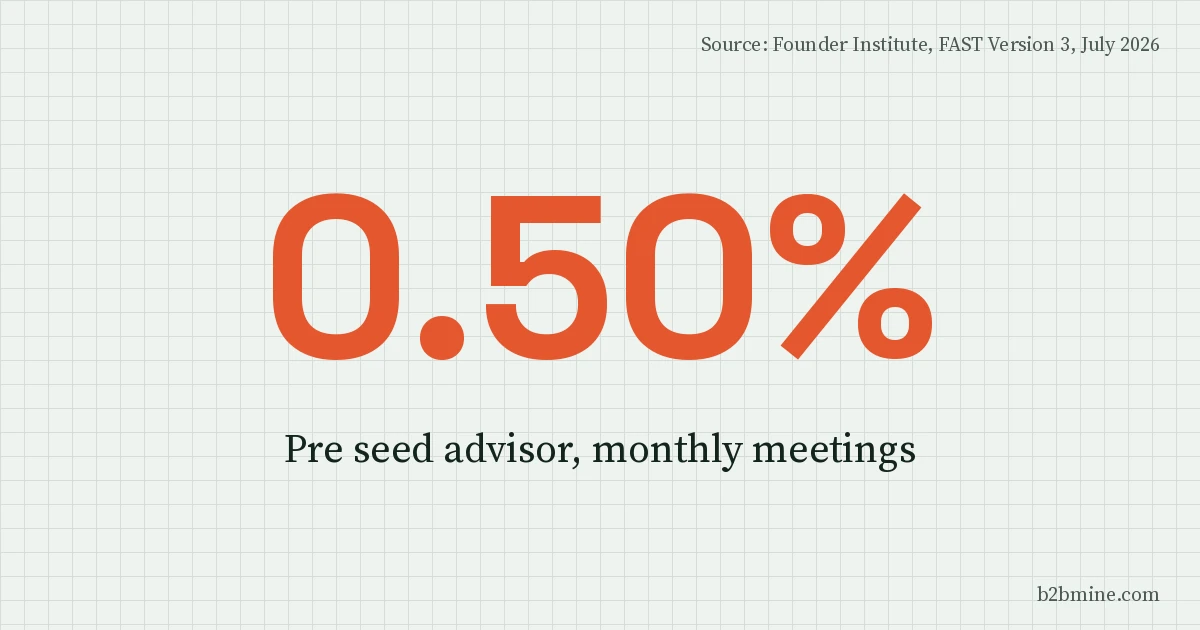
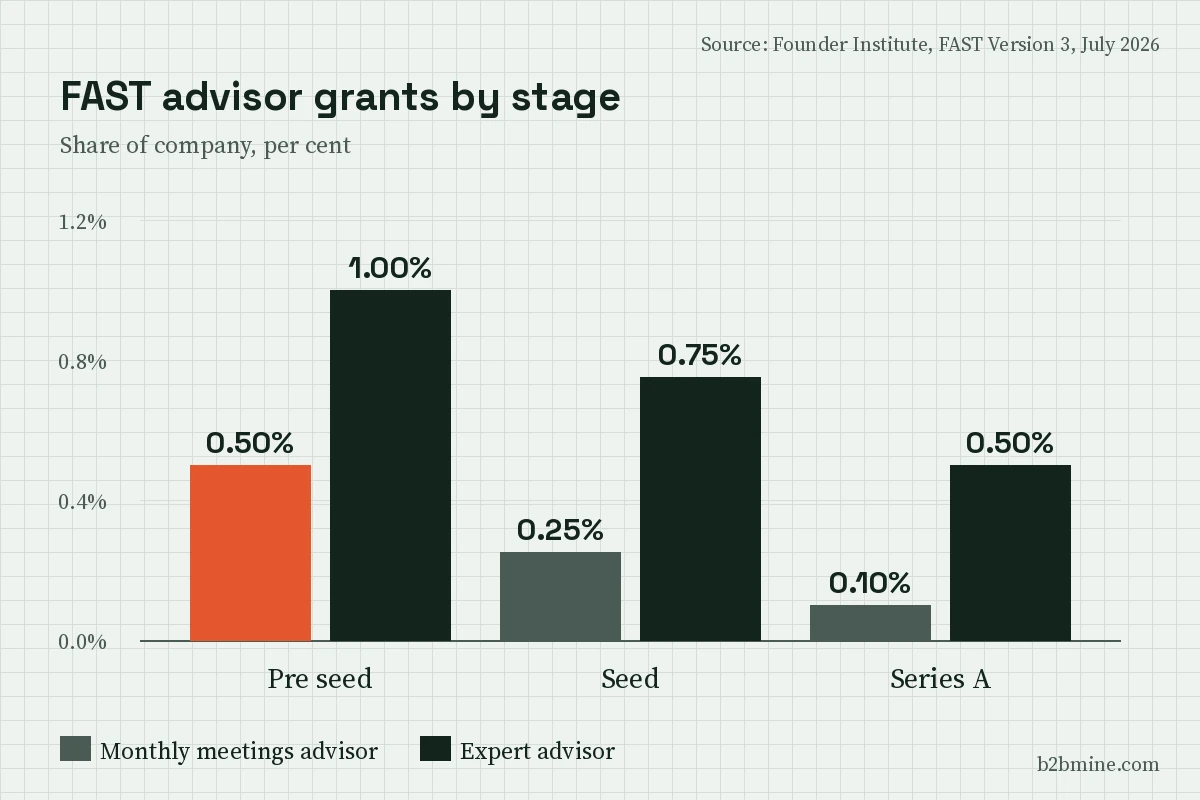
In Version 3, updated July 2026, a pre-seed advisor who meets monthly gets 0.50%, and an expert gets 1.00%.
At Series A, the two get 0.10% and 0.50%. The percentages come from a template that the Founder Institute's programs use worldwide, so they are not data from one market.
Four conditions change it:
Stage: a monthly advisor gets 0.50% at pre-seed, 0.25% at seed, and 0.10% at Series A.
Work level: an expert advisor gets 1.00% at pre-seed, twice the monthly advisor.
Time: the grant vests over 2 years, and an unproductive relationship can end in the first 3 months with no equity allocated.
Group size: the FAST FAQ calls a 5% pool for a group of advisors not uncommon.
Pre-seed: 0.50% to 1.00% of the company
At pre-seed, the Founder Institute table gives a monthly meeting advisor 0.50%. The expert row is for an advisor who also adds contacts and projects. It gives 1.00%.
Say a made-up boat marina booking software company has 9,600,000 shares once the grant is counted.
0.50% of 9,600,000 shares is 48,000 shares, and 1.00% is 96,000 shares.
Take the 48,000-share grant. The founders and team held 9,552,000 shares before it and hold the same number after it.
This table shows the company before and after the 48,000-share grant.
Holder | Shares before | Share of company before | Shares after | Share of company after |
|---|---|---|---|---|
Founders and team | 9,552,000 | 100.0% | 9,552,000 | 99.5% |
Advisor | 0 | 0.0% | 48,000 | 0.5% |
The Founder Institute page names two forms for the grant: restricted stock or options.
The FAST FAQ adds that the agreement is not designed for traditional project consulting or work for hire.
Short answers to nearby questions.
Question | Short answer |
|---|---|
How much equity should a startup give an advisor? | Under FAST, 0.10% to 1.00% of the company, by stage and work level (Version 3, July 2026). |
What does a monthly meeting advisor get at pre-seed? | 0.50% of the company under FAST Version 3. |
What does an expert advisor get? | 1.00% at pre-seed, 0.75% at seed, and 0.50% at Series A under FAST Version 3. |
How long do advisor shares vest? | FAST's example vests over two years. In the example company, 48,000 shares vest at 2,000 per month. |
Can the relationship end early with no equity? | FAST allows an unproductive relationship to end in the first three months with no equity allocated. |
How big is an advisory board pool? | The FAST FAQ says a 5% pool for a group of advisors is not uncommon. |
Is there a US tax deadline for advisor stock? | For restricted stock that vests, an 83(b) election is due within 30 days of the transfer (IRS Form 15620, Rev. April 2025). |
Does advisor equity dilute the founders? | Yes. In the example, one monthly advisor takes 0.5% and leaves the founders and team with 99.5%. |
How many monthly advisors fit in a 5% pool? | Ten, at 0.50% each. In the example company, that is 480,000 shares. |
Seed: 0.25% to 0.75% of the company
At seed, the table gives the monthly advisor 0.25% and the expert 0.75%.
On the same 9,600,000 shares, 0.25% is 24,000 shares, half of the pre-seed monthly grant. 0.75% is 72,000 shares, three-quarters of the pre-seed expert grant.
Say the company adds one monthly advisor and one expert at seed. 24,000 plus 72,000 is 96,000 shares. That is 1.00% of the company.
Series A: 0.10% to 0.50% of the company
At Series A, the monthly advisor gets 0.10%, and the expert gets 0.50%.
On the same 9,600,000 shares, 0.10% is 9,600 shares. 0.50% is 48,000 shares.
The expert grant at Series A is the same size as the monthly grant at pre-seed.
A monthly advisor and an expert at Series A hold 9,600 plus 48,000 shares. That is 57,600 shares, or 0.60% of the company.
Advisory board: 5% of the company in all
The FAST FAQ says it is not uncommon for a technology startup to set aside 5% of its equity for a group of advisors. In the example company, 5% is 480,000 shares.
Ten monthly advisors at pre-seed rates use all of it. Each takes 48,000 shares.
Five experts at 1.00% each use the same 5%. Each takes 96,000 shares, and five of them hold 480,000.
For a hired role at the same stage, see a CTO's share at the same stage.
Grants for every other role and stage sit under equity for every role and stage.
Later rounds: 0.50% falls to 0.34%
The advisor's 48,000 shares stay 48,000. Their share of the company falls with each round.
Software seed and Series A rounds on Carta each sold a median 18% of the company in the six months to 10 July 2026.
A round that sells 18% leaves every old holder with 82% of their share. 82% of 0.50% is 0.41%.
A second round at 18% leaves 82% of 0.41%. That is 0.34%.
Vesting: 2 years with a 3-month exit window
FAST's own example vests a pre-seed expert grant over two years. Apply the same schedule to the 48,000-share monthly grant. 48,000 shares over 24 months is 2,000 shares a month.
Say the shares vest each month evenly, so 12,000 have vested at month 6 and 24,000 at month 12. At month 24, all 48,000 have.
The 96,000 share expert grant vests 4,000 shares a month on the same schedule. After 12 months, 48,000 shares have vested.
If the relationship ends in month 2, the FAST page says no equity is allocated.
The Founder Institute recommends at least one month and 8 hours of work with a possible advisor before the FAST Agreement comes up.
The agreement also lets an unproductive relationship end early.
terminated without having the burden of allocating any equity
From the FAST Agreement page, Version 3, published by the Founder Institute in July 2026.
US tax: 30 days for restricted stock
IRS Form 15620, revised April 2025, sets the deadline for an 83(b) election at 30 days after the date the property was transferred.
The form applies when property that has not vested is transferred for services.
The person who performs the services makes the election, so an advisor files it, not the company.
A tax professional can say whether an election fits a given grant.
Write down your stage, the advisor's work level, and the vesting you plan to offer. Then open the papers an advisor signs.
This is general information. Have a startup lawyer check your own papers before you sign.