
A startup equity agreement template needs to match the recipient and the company. For US founders forming a Delaware corporation, Cooley GO publishes a founder stock purchase package.
Advisors have a separate option: Founder Institute's FAST agreement, updated to Version 3 in July 2026.
Start with the document that covers your relationship, then check the share count, departure terms, and required approvals.
Startup equity agreement template and company type
The Cooley GO Delaware incorporation package includes a Restricted Stock Purchase Agreement and an IP assignment. Its public page limits the package to US companies incorporating in Delaware.
It also includes board action and supporting documents for shares subject to vesting.
That gives a Delaware founder a place to obtain related papers together. The publisher warns that the documents need changes for the particular transaction. Its default values carry no recommendation.
University of Pennsylvania publishes a different starting point: an annotated Founders' Collaboration Agreement.
Its clinic prepared the model under Pennsylvania law, with an LLC contemplated in the sample. The PDF has no stated revision date.
Keep those legal structures separate when choosing a file. Replacing a company name leaves the underlying clauses in place.
A corporate stock purchase and an LLC ownership interest need papers suited to their entity.
The broader startup equity topics cover the ownership decisions behind those papers.
Short answers to nearby questions:
Question | Short answer |
|---|---|
Where can I find an official founder stock template? | Cooley GO publishes a Delaware incorporation package containing a Restricted Stock Purchase Agreement. |
Is there a founder agreement before incorporation? | Penn's annotated collaboration model addresses founders working together before forming a company. |
Does an agreed percentage complete a stock grant? | Delaware corporations also need valid issuance authority, consideration and the relevant transaction documents. |
Can an advisor use a founder agreement? | Founder Institute publishes FAST specifically for advisor relationships. |
Does the same file cover an employee? | Employee awards need terms suited to the actual stock or option arrangement. |
Can a founder template document an investment? | Investor financing needs papers covering that transaction; YC publishes SAFE forms for future equity. |
Is a PDF an editable Word file? | The file format controls editing. A PDF download alone does not promise a Word version. |
Does every grant require an 83(b) election? | Eligibility depends on the property transfer and restrictions under US federal tax rules. |
Share count and ownership
“in the numbers, at the times and for the consideration”
Delaware General Corporation Law, section 152, current text accessed 2 November 2026.
For a Delaware corporation, the issuance record needs more detail than a percentage. The board can authorize shares and consideration, with delegation permitted under statutory conditions.
The agreement and the approval must describe the same transaction.
A small difference in the denominator changes the offer.
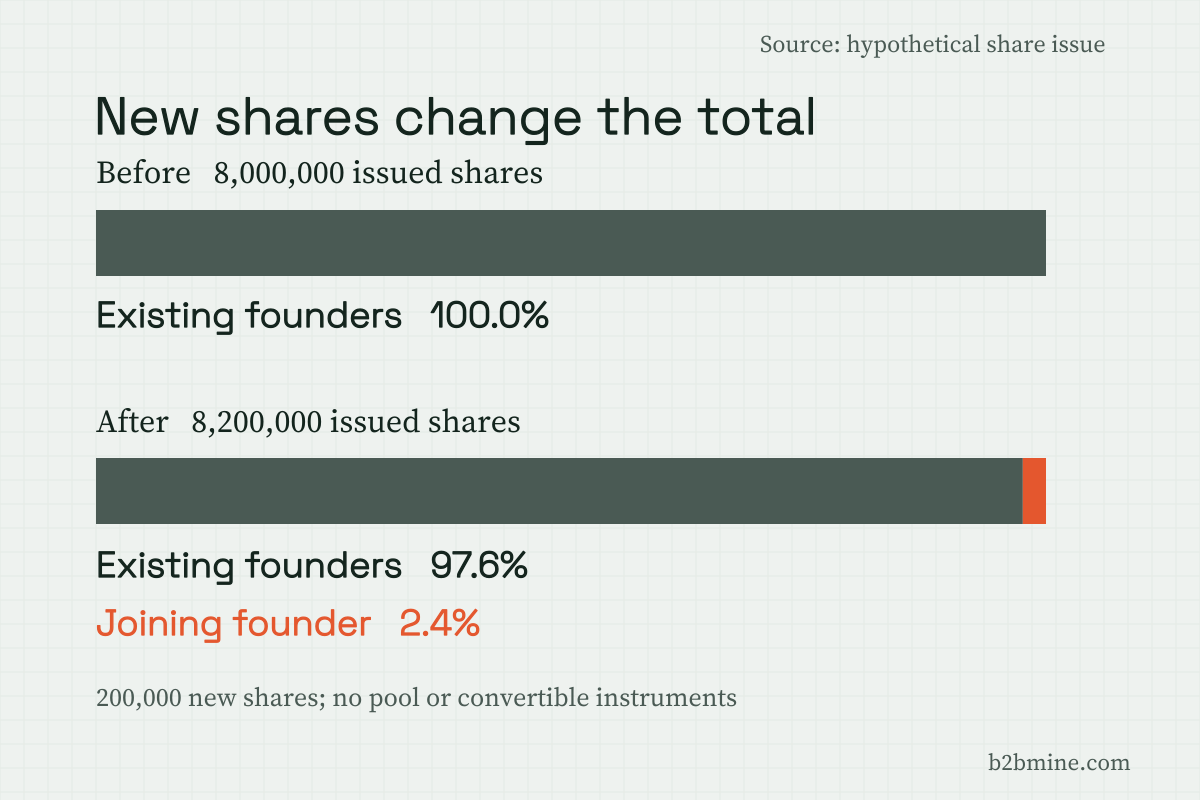
Say a made-up warehouse software company has 8,000,000 issued common shares. Its founders discuss giving a joining founder 200,000 newly issued shares.
This example assumes no options, reserved pool, convertible instruments, or other share classes.
The company would have 8,200,000 issued shares after that issue.
The joining founder would hold about 2.4% of the company. An exact 2.5% of the existing share count produces a different result after new shares enter the total.
These figures show the assumed new issue, before any later fundraising.
Holder | Shares before | Share of company before | Shares after | Share of company after |
|---|---|---|---|---|
Existing founders | 8,000,000 | 100.0% | 8,000,000 | 97.6% |
Joining founder | 0 | 0.0% | 200,000 | 2.4% |
Total | 8,000,000 | 100.0% | 8,200,000 | 100.0% |
A transfer from an existing founder gives another result. If that founder transfers 200,000 existing shares, the total stays at 8,000,000. The recipient then holds 2.5%.
Neither example includes an option pool. If the offer uses a fully diluted share count, ask which additional instruments enter it.
Write that basis beside the percentage so both parties can reproduce the calculation.
Get these answered first:
Is the company issuing new shares or is someone transferring existing shares?
Which share count supports the percentage in the agreement?
What class of shares will the recipient receive?
Does the approval show the same count and price?
Vesting and founder departures
“Right of Repurchase”
Founder Stock Purchase and Shareholder Rights Agreement of Consumer Cooperative Group, Inc., dated 27 January 2017, filed on SEC EDGAR.
That Oregon cooperative's filed agreement connects unvested shares to a company repurchase option. It also sets a notice process and a period for exercising the option.
Those are transaction terms in that filing, with no claim that they suit another company.
For your own papers, the practical questions include who can buy shares back and at what price. A statement that shares “vest” leaves those questions unanswered.
Return to the made-up warehouse software company. Assume the joining founder buys 200,000 shares for $0.01 each. The purchase costs $2,000.
Suppose its negotiated papers use 48 months of vesting with a 12-month cliff. These are example inputs, rather than a recommended schedule. Assume 25% vests at the cliff, followed by equal monthly portions.
At the end of month 12, 50,000 shares are vested.
By the end of month 18, 75,000 shares are vested. The other 125,000 remain unvested.
Assume the company can repurchase those unvested shares for their original price. The example repurchase would cost $1,250, subject to the actual terms and applicable law.
A departure clause needs to identify what ends service and what happens next. Employment, board membership and share ownership are separate matters to address in the papers.
The example calculation alone cannot decide which rights survive departure.
Questions for your lawyer:
Which departure events activate the repurchase right?
Who must send notice, and by what deadline?
What price applies to each affected share?
What happens to vested shares and voting rights?
Contributions and company IP
“Transfer of Ownership to Company Upon Formation”
Penn Founders' Collaboration Agreement, undated clinic model prepared under Pennsylvania law.
Penn's model deals with transferring the business concept to the company when it forms. Its annotations also address contributions and possible claims from other contributors.
For a founding team, cash and work need separate records. The share purchase price records what the person pays for shares. The IP papers record the rights the company receives.
Consider an extension of the made-up example. The joining founder contributes existing warehouse scheduling code and pays the assumed $2,000 share price. The team also plans future development work.
A payment receipt would record the cash. An IP schedule could identify the existing code, its owner, and any excluded material. Future work would need coverage in the appropriate signed agreement.
Before the meeting, put the repository name and the relevant contracts beside that schedule. If a previous employer or client may own part of the work, identify that issue for counsel.
An equity percentage cannot settle another party's ownership claim.
Ask before you sign:
Which existing assets will the company receive?
Does anyone else claim rights in those assets?
Which material stays with its current owner?
Which papers cover work created after joining?
Approvals and the US tax clock
“30 days after the date the property was transferred”
IRS Form 15620 instructions, April 2025 revision.
Under US federal tax rules, eligible recipients can make an 83(b) election for substantially nonvested property transferred for services. The instructions permit Form 15620 or a written statement meeting the applicable requirements.
The deadline attaches to the property transfer. A conversation about equity does not establish that date. An ordinary unexercised option grant also does not, by itself, transfer the underlying shares.
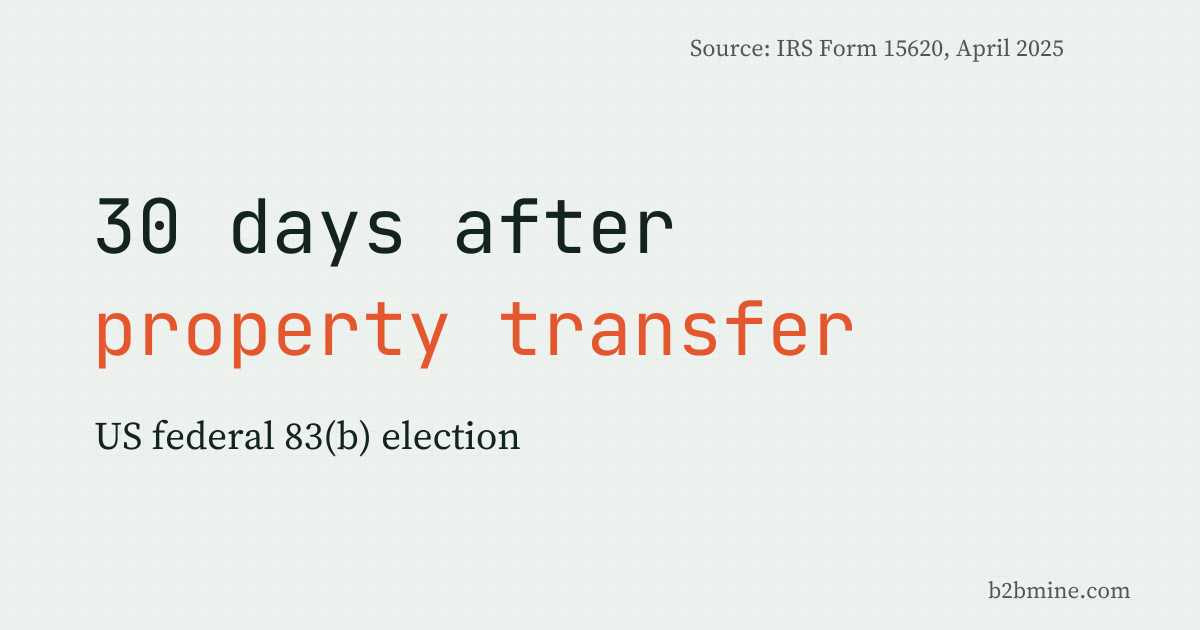
The instructions include a weekend and legal holiday rule. When the final day falls on one, the stated mailing rule uses the next qualifying day.
For the made-up company, keep the assumed share purchase and transfer records together. The tax adviser needs the actual transfer date, property description, restrictions, fair market value, and amount paid.
Those facts come from the transaction.
An option recipient needs a different review of the award and any exercise. The existing explanation of a grant's value and purchase cost covers the financial inputs separately.
Get these answered first:
On what date does the property transfer occur?
Does this transaction qualify for an election?
Who handles filing and retains evidence of it?
Do the tax figures match the signed transaction?
Voting rights and share transfers
“full or limited, or no voting powers”
Delaware General Corporation Law, section 151, current text accessed 2 November 2026.
For a Delaware corporation, the share class can affect voting powers and other rights. The ownership percentage alone cannot show which decisions the recipient controls.
Keep the class named in the grant beside the company's governing documents.
In the made-up warehouse software company, assume every issued common share carries one vote. The joining founder's 200,000 shares would carry about 2.4% of those votes after the new issue.
This assumption belongs to the example; another company's share classes can produce a different result.
The founder also wants to know whether a future buyer can purchase those shares. The Oregon cooperative's filed agreement uses a right of first refusal. Its terms require notice of a proposed transfer, including the shares, price, and proposed recipient. That contract's restrictions belong to that transaction.
A separate written promise to find a buyer would leave these restrictions unresolved. Before relying on a sale plan, gather the share agreement and any documents it incorporates.
An interested buyer alone does not establish that a transfer meets the signed terms.
Questions for your lawyer:
Which decisions can this share class vote on?
Does another agreement require company or holder consent?
Who gets the opportunity to buy before an outside buyer?
Which restrictions continue after the founder leaves?
Advisor work and investor money
“trading advice and support”
Founder Institute FAST agreement resource, Version 3, July 2026.
FAST addresses advisor relationships. Its original page links the current agreement and describes the updated advisor commitment levels. The actual award still needs to fit the company's entity, applicable law, and agreed arrangement.
For someone delivering a product or a defined service, the work may extend beyond advice. Founder Institute separately publishes EASE for equity paid for services, currently labelled Beta on its original page. That distinction matters when the expected contribution is a finished project.
Write the expected work beside the proposed award before comparing forms. Introductions, occasional advice and building a software product create different expectations. The papers need to record the actual relationship.
US securities rules also require attention. The SEC's employee benefit plan page, updated 17 March 2026, describes Rule 701 for certain compensatory sales to employees, consultants and advisors. It also warns that securities issued under that exemption face resale restrictions.
Investor money follows a separate document path.
“the right to shares”
Y Combinator SAFE resource, current publisher page accessed 2 November 2026.
YC's SAFE forms address investment for future shares. A SAFE converts under its terms; the investor's rights differ from a founder buying common shares.
Questions for your lawyer:
Is the equity paying for advice, delivered work, or an investment?
Which document records the work or funding obligation?
Which approvals and securities rules apply?
Which rights continue when the relationship ends?
Bring the proposed share count, contribution record, and departure terms to a startup lawyer. Then compare the signed terms with the numbers you plan to discuss in an equity offer.
This is general information. Have a startup lawyer check your own papers before you sign.