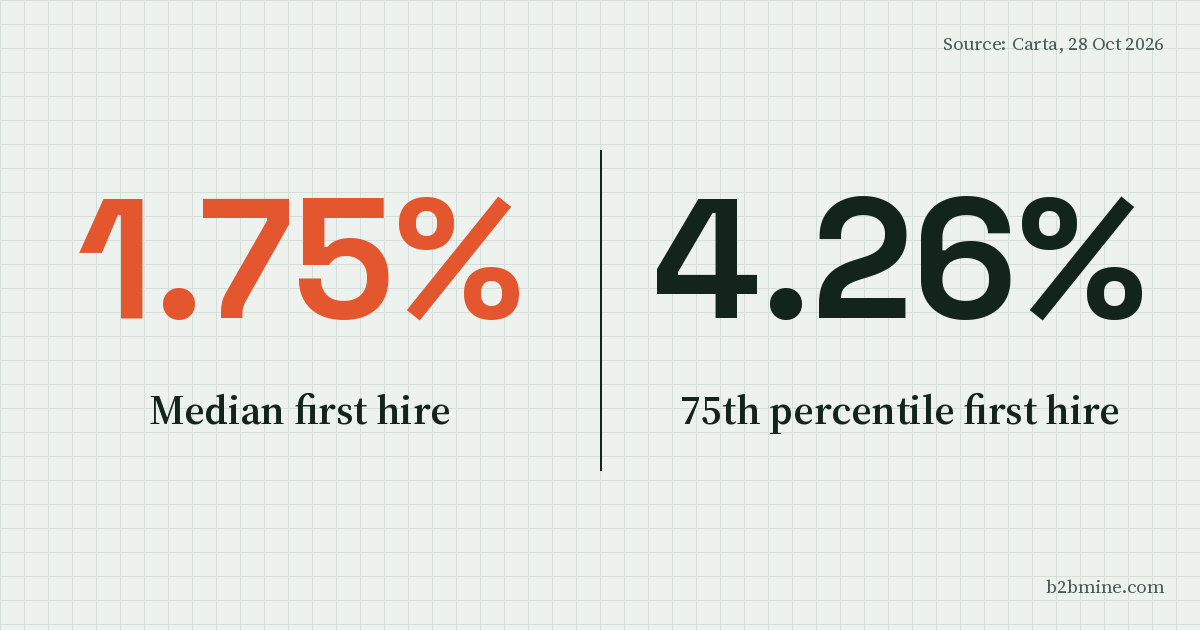
The first employee a startup hires usually gets 1.75% of the company, according to Carta in its report of 28 October 2026.
Later hires get less, and so do lower levels. Typical equity for startup employees therefore falls from 1.75% for the first hire to about 0.024% for a median new hire in product.
The data covers US startups that use Carta.
1.75% for the first hire, then smaller grants
Carta's median first hire got an initial grant of 1.75% of the company over the past two years. The 75th percentile for first hires was 4.26%.
Carta says the median keeps climbing from its earlier reports.
After the first hire, the median grant drops fast. By hires eight, nine, and ten, the medians are almost the same size.
The first technical hire has its own page: what a founding engineer gets.
1.00% to 0.15% for engineers at seed
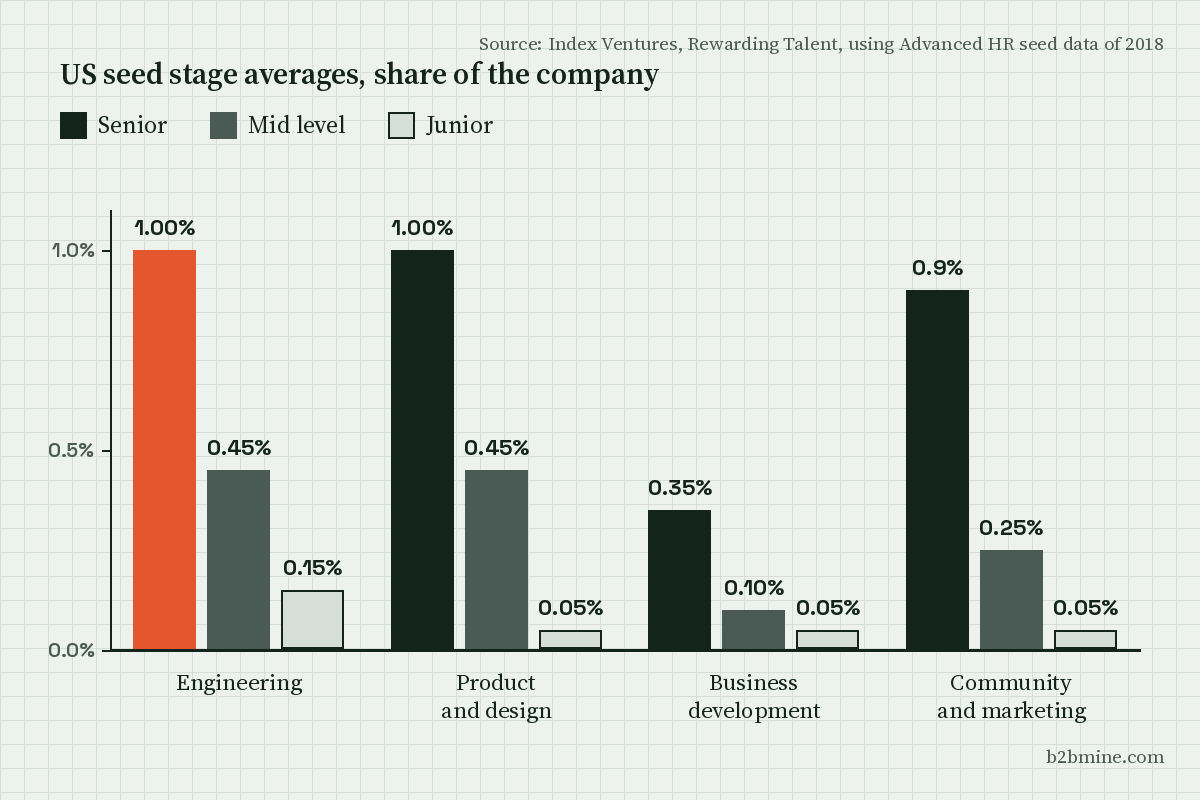
Index Ventures lists average US seed-stage grants by function and level, taken from Advanced HR seed data of 2018. A senior engineer got 1.00% of the company on average. A mid-level engineer got 0.45%, and a junior engineer got 0.15%.
Product and design ran 1.00%, 0.45% and 0.05% over the same three levels. Business development ran 0.35%, 0.10% and 0.05%. Community and marketing ran 0.9%, 0.25% and 0.05%.
Index puts a seed team of ten at about 5% of the company in total, which it calls close to the US average.
Short answers to nearby questions:
Question | Short answer |
|---|---|
How much equity do early startup employees get? | The median first hire gets 1.75% and the 75th percentile gets 4.26% (Carta, 28 October 2026). |
What is typical startup equity at Series A? | Carta's median option pool is 15.1% at Series A, and every employee grant comes out of it (Carta, 28 October 2026). |
How much equity do the first 10 employees get? | About 5% in total for a seed team of ten, close to the US average (Index Ventures, updated edition of a 2017 guide). |
How much equity does a senior engineer get? | At seed, 1.00% on average, against 0.45% for mid level and 0.15% for junior (Index Ventures, Advanced HR data of 2018). |
Does equity differ by function? | Yes. A median new product hire got about seven times the equity of a median administrative hire (Carta, 28 October 2026). |
How big is the option pool? | The median pool is 12.9% at seed and 15.1% at Series A (Carta, 28 October 2026). |
Are employee grants getting bigger? | For mid level individual contributors, yes: up 25.4% since Q1 2024. VP grants fell 9.7% (Carta, 28 October 2026). |
How is a grant sized from salary? | Index sets a senior engineer at 50% of base salary and a senior sales hire at 10% (Index Ventures, updated edition of a 2017 guide). |
25.4% more for mid-level, 9.7% less for VPs
In its full report, State of Startup Compensation: H1 2026, Carta compared each level's median first grant with the median in Q1 2024 (January to March 2024).
The table shows the change.
Level | Change in the median first grant since Q1 2024 |
|---|---|
Entry level through senior manager | Up at least 16% at every level |
Upper mid-level individual contributor | Up 25.4% |
Director | Up 10.3% |
Senior director | Up 3.9% |
VP | Down 9.7% |
Over the past year alone, entry-level individual contributors saw the biggest rise at 10.7%.
Managers were the one group that fell, by 2.2% from the first half of 2025 to the first half of 2026.
0.024% for a median product hire
Through the end of H1 2026 (January to June 2026), a median new hire in product started at a $180,600 salary and an initial grant of about 0.024% of the company.
That hire got roughly seven times the equity of a median administrative hire.
Function moves the grant as much as level does.
Over the past year, the median operations grant grew 20.9%. In H1 2026, the finance grant was 1.2% smaller than in H1 2025, and the strategy grant was 2.8% smaller.
Typical equity for startup employees at Series A
Every grant comes out of the option pool. Carta's median pool holds 12.9% of the company at seed, and 15.1% at Series A, and each new round adds one to two percentage points.
Index says a US pool grows from 10% at seed to 15% at Series A, and that a Series A pool will most likely land between 10% and 15%.
Index sizes grants from salary, not from a share of the company. Between Series A and Series B, a senior hire in engineering, product, or business development gets options worth 50% of base salary.
A senior marketing, finance, or HR hire gets 20%, and a senior sales hire gets 10%. VP and C-level hires get fixed dollar amounts, $100,000 and $250,000 in Index's table.
Index's own plan has 50 hires at a notional $25 million post-money valuation. The grants total $1.6 million, which is 6.4% of the company. Hires made before the Series A add about 4%, so the plan reaches 10.4%.
A salary-based grant keeps its dollar value as the valuation rises, so the number of options falls. Index calls salary a reasonable yardstick for the value of each employee.
69,400 options from a 1,500,000 share pool
Say a made-up parking permit software company closes a Series A at a $25 million post money value.
It has 10,000,000 shares in all, so a share sells for $2.50 in the round. The option pool holds 1,500,000 shares, which is 15.0% of the company.
Four hires arrive before the next round, and each grant follows Index's method.
A VP gets $100,000 of options. $100,000 divided by $2.50 is 40,000 options.
A senior engineer has a made-up $120,000 salary. 50% of $120,000 is $60,000, which buys 24,000 options.
A marketing hire has a made-up $70,000 salary. 15% of $70,000 is $10,500, which buys 4,200 options.
A sales rep has a made-up $60,000 salary. 5% of $60,000 is $3,000, which buys 1,200 options.
The four grants total 69,400 options, worth $173,500 at $2.50. The pool falls from 1,500,000 shares to 1,430,600.
The table shows who holds what before and after the grants.
Holder | Shares before | Share of company before | Shares after | Share of company after |
|---|---|---|---|---|
Option pool | 1,500,000 | 15.0% | 1,430,600 | 14.3% |
Four new hires | 0 | 0.0% | 69,400 | 0.7% |
Everyone else | 8,500,000 | 85.0% | 8,500,000 | 85.0% |
The senior engineer's 24,000 options are 0.24% of the company. The sales rep's 1,200 options are 0.012%.
Check these before you use the number:
your level: Carta shows VP grants down 9.7% since Q1 2024 while mid-level grants rose 25.4%.
your function: a median new product hire gets about seven times the equity of a median administrative hire.
The stage: the median pool is 12.9% at seed and 15.1% at Series A, and every grant comes out of it.
The valuation: a salary based grant keeps its dollar value, so a higher valuation buys fewer options.
The equity posts for other roles cover advisors, a CTO, founders, and investors.
Open your offer and find three numbers: the options granted, the shares in the whole company, and the price per share. Then work out what your options are worth.
Use these figures as a starting point, then ask a startup lawyer about your own deal.