Y Combinator's standard deal buys part of your company on two SAFEs. As of 16 November 2026, Y Combinator invests $500,000: $125,000 buys a fixed 7% of the company, and the other $375,000 goes on an uncapped MFN SAFE that takes the terms of your lowest cap SAFE.
A Y Combinator equity calculator for this deal needs one input beyond the 7%: the cap on your other SAFEs. The terms apply to every company accepted into YC.
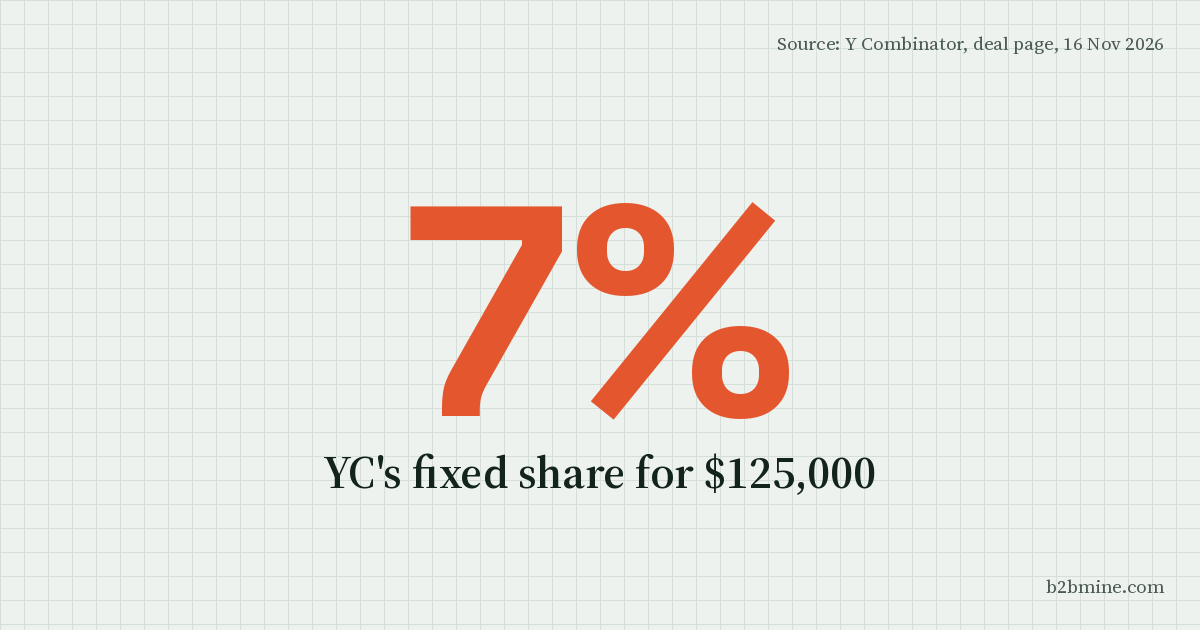
The rule fits in one sentence. YC's share before your priced round is 7% plus $375,000 divided by the lowest post-money cap among your other SAFEs.
If your other SAFEs cap at $7.5 million
Say a made-up two-founder salon payroll software company is accepted into YC. The founders hold 10,000,000 shares.
After the batch starts, the company signs a $600,000 SAFE with a $7.5 million post-money cap.
That SAFE buys 8% of the company. $600,000 divided by $7.5 million is 8%.
The MFN SAFE takes the lowest cap among your other SAFEs, and here that is $7.5 million.
It converts on the terms of the lowest cap SAFE issued after the MFN start date, which falls around the start of the batch. $375,000 divided by $7.5 million is 5%.
on the terms of the lowest cap SAFE
Y Combinator's standard deal page describes the MFN SAFE this way, and it shows no edition date.
The fixed SAFE buys 7%. That is the same as a post-money cap of about $1.79 million, since $125,000 divided by 7% is $1,785,714.
Together, the three SAFEs hold 20%, so the founders keep 80%.
For the founders to hold 80%, the company needs 12,500,000 shares. 10,000,000 divided by 80% is 12,500,000.
YC's fixed SAFE gets 875,000 of those shares, and the MFN SAFE gets 625,000. The other SAFE gets 1,000,000. YC holds 12.0% before the priced round.
Short answers to nearby questions:
Question | Short answer |
|---|---|
How much equity does Y Combinator take? | 7% for $125,000, plus the MFN SAFE's share once your other SAFEs set a cap (Y Combinator, 16 November 2026). |
How much is the MFN SAFE at a $15 million cap? | 2.5%, which is $375,000 divided by $15 million (Y Combinator, 16 November 2026). |
Does a discount change the MFN SAFE? | It can. The MFN SAFE also takes a better term, such as a discount, from a SAFE you sign later (Y Combinator, 16 November 2026). |
What converts first in a priced round? | SAFEs convert first, then the pool is created or increased, then new money comes in (Y Combinator, 16 November 2026). |
Does the option pool dilute Y Combinator? | Yes. The deal page says the priced round and the pool both dilute YC's ownership (Y Combinator, 16 November 2026). |
Can YC invest in later rounds? | Yes. YC has a pro rata right to buy part of the new money in later rounds (Y Combinator, 16 November 2026). |
Does Y Combinator charge fees? | No. The deal page says YC charges companies no fees to take part (Y Combinator, 16 November 2026). |
Does the $500,000 depend on milestones? | No. YC says the investment is not tied to milestones, and it starts the day a company is accepted (Y Combinator, 16 November 2026). |
If a Series A adds a pool and sells 15%
Y Combinator's page says three things happen in the priced round, and the order matters. First, all SAFEs convert into preferred shares. Second, a stock option pool is created or increased.
Third, new money comes in. The page adds that the round and the pool both dilute YC.
Say the Series A creates a 5% pool and sells 15% to new investors. Together they hold 20% after the round, so the existing 12,500,000 shares become 80% of the company.
The company then has 15,625,000 shares in all. 12,500,000 divided by 80% is 15,625,000.
The pool gets 781,250 shares, and the new investors get 2,343,750. Together, that is 3,125,000 new shares.
The table shows each holder before and after the round.
Holder | Shares before | Share of company before | Shares after | Share of company after |
|---|---|---|---|---|
Founders | 10,000,000 | 80.0% | 10,000,000 | 64.0% |
YC fixed SAFE | 875,000 | 7.0% | 875,000 | 5.6% |
YC MFN SAFE | 625,000 | 5.0% | 625,000 | 4.0% |
Other SAFE | 1,000,000 | 8.0% | 1,000,000 | 6.4% |
Option pool | 0 | 0.0% | 781,250 | 5.0% |
New investors | 0 | 0.0% | 2,343,750 | 15.0% |
YC holds 1,500,000 shares after the round, which is 9.6%. The founders hold 64.0%.
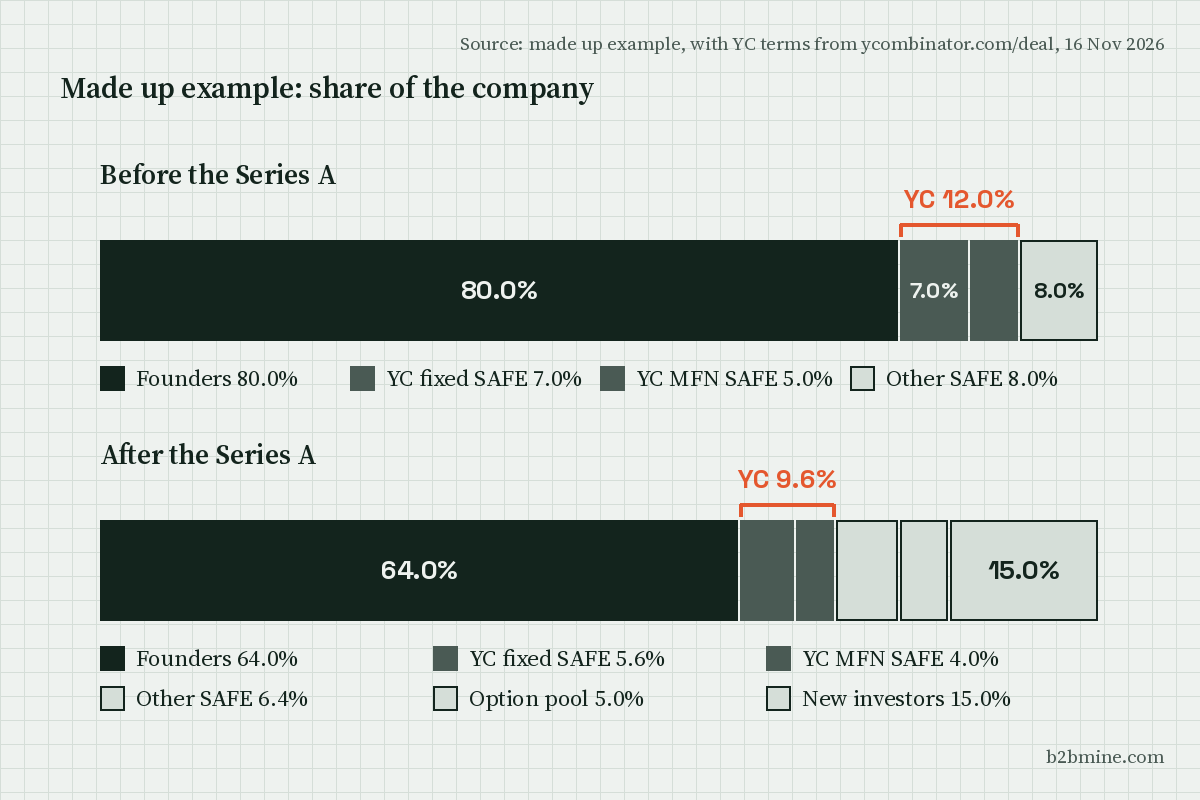
A bigger round cuts every holder more. If the new investors buy 25% instead of 15%, the existing shares are 70% of the company after the pool. YC falls to 8.4% and the founders fall to 56.0%.
A bigger pool does the same, and the deal page says it dilutes YC too. With a 10% pool and 15% new money, the existing shares are 75% of the company. YC holds 9.0% and the founders hold 60.0%.
For the founders' share at each stage in the market, see what the median founder keeps at each round.
If the same SAFE caps at $15 million or $37.5 million
A higher cap shrinks the MFN SAFE's share. The deal page's own example uses a $15 million cap and gets 2.5%. The table keeps the $600,000 SAFE and moves its cap.
Cap on the $600,000 SAFE | MFN SAFE share | YC total before the round | Founders keep before the round |
|---|---|---|---|
$7.5 million | 5.0% | 12.0% | 80.0% |
$15 million | 2.5% | 9.5% | 86.5% |
$37.5 million | 1.0% | 8.0% | 90.4% |
A lower cap raises the MFN share, and it raises the share of the SAFE that set the cap.
After the same Series A, every holder keeps 80% of its share. YC falls to 9.6%, 7.6% and 6.4% across the three caps. The founders fall to 64.0%, 69.2% and 72.3%.
If you sign a second SAFE at a $10 million cap
Say the company signs a second SAFE after the first one, for $400,000 at a $10 million post-money cap. The MFN SAFE takes the lowest cap among your other SAFEs, which is still $7.5 million, so it stays at 5%.
The second SAFE buys 4%. $400,000 divided by $10 million is 4%.
The four SAFEs now hold 24% together, so the founders keep 76%. YC still holds 12.0%, because each post-money SAFE fixes its own share of the company. A second SAFE with a higher cap takes its share from the founders, not from YC.
After the same Series A, the founders hold 60.8%, and YC holds 9.6%.
If you need a Y Combinator equity calculator
A working calculator for this deal needs four lines. Copy them and fill in your own numbers:
Cap: the lowest post-money cap among your other SAFEs, in dollars.
MFN share: $375,000 divided by your cap.
YC total: 7% plus your MFN share.
Your share: 100% minus YC total, and minus each other SAFE's share, which is its amount divided by its cap.
Each other SAFE with a cap is a candidate for the MFN SAFE, and the lowest cap wins.
With no other SAFE, the MFN SAFE has no cap to take, so the second line has no number to use yet.
Enter $7.5 million and the $600,000 SAFE, and your lines should give 5%, 12.0% and 80.0%. Run the four lines again for each cap you are weighing.
Then take off the pool and the new money, as in the Series A step above.
Your figure goes up or down with:
the lowest cap on your other SAFEs: a lower cap raises the MFN share, as the table shows.
the pool and the new money: both cut every holder's share, YC's included.
YC's pro rata right: if YC buys part of the new money, its share ends above 9.6% in the example.
the type of SAFE: the deal page's math assumes your other SAFEs were issued on a post money basis.
Questions for your lawyer:
What is the exact MFN start date in my YC paperwork?
Which of my SAFEs were issued after that date?
Is each of them post money?
What pool percentage will the Series A investors ask for?
The equity posts for founders cover the other rounds and roles.
Run the four lines on your own SAFEs and write down YC's total. Then see what a Series A takes from every holder.
Nothing here is legal or tax advice. A lawyer who works with startups can check your case.